THE CITY BEFORE THE ROOM
Varanasi arrives as sound. Not the sound of the city itself, but the sound of the city not yet being the city. Morning. Pre-dawn. The ghats are still waking up. Kabir has come here before, but not for this. Not for a ledger. Not for numbers that pretend to be holy. The temple complex sits back from the river, insulated from the chaos by thick walls and older architecture. Walls that have absorbed centuries of prayer and have become porous to nothing.
Kabir walks through the outer courtyard. The stone is cold under his feet. The sky is the colour of water just before it becomes day. The only sound is the sweep of a broom somewhere distant, and the low murmur of a priest chanting inside the inner sanctum. The accounting room is behind the main hall.
Not secret. Just not visible. A room that exists because even temples need to know where the money goes.
ENTERING THE ROOM
The room is small. Smaller than the Surat sorting office. The ceiling is low. The walls are stone. The single window faces east. The morning light comes through it in a shaft, illuminating dust motes that have been floating in this same air for decades. The smell: old paper, incense, the particular mustiness of ledgers opened and closed for generations. And something else — the smell of absence.
The room had a sound missing from it too. For twenty-three years this room had held the specific rhythm of a man counting under his breath — the small mutter of a tally being kept, coins and notes being separated by denomination, the particular cadence of someone whose fingers know money the way a musician's fingers know an instrument. And the way he held the pen — not gripped, but balanced, the way a man balances a thing he has done ten thousand times and no longer needs to think about. The pen moved before the thought finished.
That sound was gone now. The silence where it used to be was louder than any other silence in the room. A desk sits in the centre of the room. On it: a ledger. Open. A pen. A pair of spectacles. And a pair of slippers. Positioned neatly under the desk, as if the person who wore them intends to come back and put them on again.
The priest — his name is Vishwanath Tiwari — has not been seen for eight days.
THE TWO PEOPLE WAITING
The head priest, Acharya Shukla, sits on one side of the desk. Sixty-eight. Thin. The kind of thinness that comes from a lifetime of fasting and restraint. His hands are on his knees. Not positioned. Resting. The difference Kabir noted in Surat is relevant here too. Acharya Shukla's hands are truly resting. They have nothing to hide.
His face is composed. Not the composed of control, but the composed of acceptance. He is a man who has already made peace with whatever this room is about to reveal. The accountant, Ramesh Bhatt, stands near the door. Fifty-two. Round. Sweating.
His hands are in his pockets. The gesture means nothing by itself — cold hands, habit, discomfort and concealment can all look the same. What makes Kabir note it is the rest of the arrangement: Ramesh has chosen the farthest point from the desk, and every time the ledger is mentioned his fingers press deeper into the cloth.
Ramesh Bhatt is sweating in a room that is not warm.
THE OBJECT
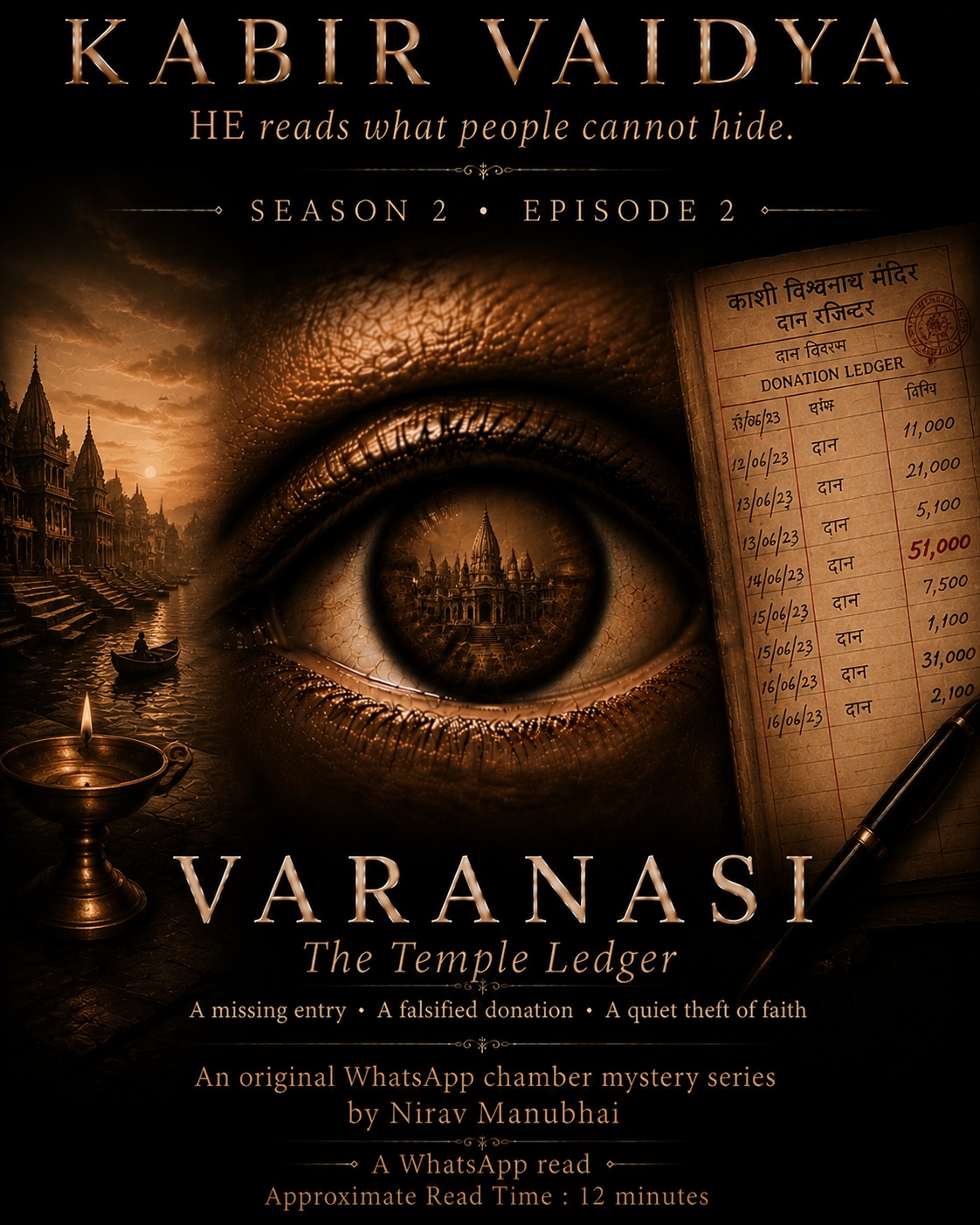
The ledger sits open. The page is dated eight days ago. The entries are in handwritten Devanagari script. Donations. Offerings. The daily accounting of a temple that has been managing money for three hundred years. One entry is incomplete. It stops in the middle of a sentence. The pen lies beside it. The ink has dried. Someone put the pen down and never picked it up again.
Kabir leans closer and traces the last line with his eyes, not his finger. The entry breaks off mid-word, but the word itself is legible: Kshama. Forgiveness. Not a donor's name. Not a sum. A man writing the daily accounts of a temple had begun to write the one word that has nothing to do with money, and had stopped there, pen down, before finishing whatever sentence it belonged to.
He had begun a word he could not complete — perhaps because he did not yet know who he was asking, perhaps because some words are easier to begin than to finish. The slippers under the desk are simple rubber, worn unevenly at the heel — the particular wear pattern of a man who walks slightly on the outer edge of his right foot, a habit no one notices in a person but that a slipper remembers perfectly.
The imprint of his foot was still readable in the rubber: the slight depression where his big toe pressed down, the flattened arch. The slipper had held his weight for twenty-three years. It had not stopped holding the shape even though the man was gone. Kabir looks at the slippers. Then at the chair behind the desk. Then at the door.
"Nobody moved them," Acharya Shukla says. "We left everything as it was."
WHAT KABIR READS IN THE ROOM
The slippers: positioned exactly as a person would position them when they stand up. Not kicked off. Not pushed aside. Placed. The person who stood up intended to return. The chair: pushed back slightly from the desk. Not far enough to indicate urgency. Far enough to indicate someone standing up to stretch. Or someone standing up to leave for a moment.
The ledger: open at the page of the last entry. The handwriting stops mid-sentence. The ink is uniform — no sign of hesitation, no crossing out. The person was writing and stopped. Not because they were interrupted. Because they decided to stop. The dust: denser near the desk than anywhere else in the room. As if someone has been moving around it recently. Disturbing the air.
"Who has been in this room since the disappearance?"
Ramesh Bhatt shifts his weight. His hands come out of his pockets. Then go back in.
"I have. Checking the ledgers. Making sure everything is in order."
"Why would everything not be in order?"
THE HISTORY UNSPOKEN
Vishwanath Tiwari was not an ordinary priest. He was the accounting priest. The one who kept the books. The one who recorded every offering, every donation, every rupee that came into the temple's coffers. He had been doing it for twenty-three years. Before him, his father did it. Before that, his grandfather. Three generations of accounting priests. Three generations of men who understood that a temple runs on both prayer and money.
Acharya Shukla trusted him completely. Everybody trusted him. The temple's accounts were a model of transparency. Audited annually. Published quarterly. Nothing to hide.
"Until eight days ago," Kabir says.
"What happened eight days ago?"
Acharya Shukla's hands remain on his knees. His breathing is steady. His eyes are steady. But there is something in his voice. A tremor. Not of deception. Of grief.
"An external auditor arrived. The temple has an audit annually, but this was an additional one. Random. Surprise. The kind that is triggered by... concern."
"Concern from whom?"
"From a donor. A large donor. They requested a review of the donations. Said the records did not match their own."
THE DISCREPANCY
The donor's bank records showed transfers totalling 11 lakh rupees over eighteen months. The temple's bank account showed the same 11 lakh received. No money was missing. The ledger told a different story. Nine lakh appeared against the donor's name. The remaining two lakh had been split across several entries marked general offering — without a donor name or supporting receipt.
The money was all there. But two lakh of it had been made to disappear on paper — attributed to nobody, traceable to nothing. In a temple that accepted no anonymous donations, that was the system: not theft, but erasure of identity.
"There are no anonymous donations in this temple," Acharya Shukla says. "We do not accept anonymous donations. Every donation is recorded with the donor's name, address, and PAN. It is the rule."
"Who made the rule?"
"I did. Twenty-three years ago."
"What did Vishwanath say when the discrepancy was found?"
"Vishwanath said nothing. He was not there. He had already... left."
THE MOMENT OF DISAPPEARANCE
Eight days ago. The auditor arrived at 9 AM. Vishwanath Tiwari was at his desk. The ledger was open. The auditor asked for the previous month's donation records. Vishwanath provided them. The auditor began to cross-reference. At 10:15, Vishwanath stood up. He said he needed to use the washroom. He walked out of the room.
His slippers remained under the desk. He never returned. The auditor continued to work. At noon, someone finally asked why Vishwanath had not returned. The temple was searched. The police were called. A courtyard camera showed him crossing the service passage at 10:18, barefoot, without his phone, wallet or keys. At the lane outside, the camera lost him in the morning crowd. The railway station, bus stands, hospitals and ghats were checked. Eight days later, there was still no confirmed sighting.
The auditor said later that Vishwanath had looked at him for a long moment before standing. Not the look of a man fetching records. The look of a man deciding something. The auditor had thought he was deciding whether to bring the previous month or the month before. He was not. Everything he normally carried was in the room.
Except Vishwanath.
WHAT KABIR READS IN THE BODY
Ramesh Bhatt's hands have come out of his pockets again. They are clasped in front of him. The knuckles are white. He is pressing his hands together as if trying to squeeze something out of himself. His eyes: darting. Looking at the ledger, then at Kabir, then at Acharya Shukla, then at the door. A person who is trying to find an exit that does not exist.
He is standing as far from the desk as possible. A person who is trying to distance themselves from an object that has become dangerous. Acharya Shukla's hands remain on his knees. His eyes are steady. He is not afraid. He is grieving.
WHAT KABIR ASKS
"Ramesh Bhatt. When did you first know about the discrepancy?"
Ramesh's knuckles become whiter. "I did not... I did not know."
"When did you first know?"
"I... the auditor found it. That is when I knew."
"You did not know before the auditor arrived?"
"No."
"Vishwanath told you nothing?"
"He told me nothing."
"Vishwanath was your friend. You worked together for eight years. He told you nothing?"
Ramesh's hands begin to shake. The clasped hands are no longer clasped. They are pressing against each other, trying to stop the shaking. Not succeeding. This was a different shaking from fear. It had a slower rhythm — the body of a man not protecting a secret anymore but finally letting it leave him, the way a held breath leaves the chest in stages rather than all at once.
"He told me... he told me there was something he had to fix. Something from before. Something his father had done."
He said it once. We were locking up after the evening accounts. He didn't look at me when he said it. He said his father had a name for it — he called it "keeping the peace." One donor, once a year, whose name never appeared on any line. The family had been giving to this temple for forty years. His father decided the giving mattered more than the record. He said — "Some things stay in a room even after the person who brought them in is gone."
THE REAL HISTORY
Vishwanath Tiwari's father had kept the accounts before him. For twenty-two years. The accounts were always clean. Always transparent. Always audited. But the father had a system. A small system. The kind of system that becomes normal because nobody questions it. The father would occasionally record a donation as "anonymous" when the donor requested it. Not because the temple accepted anonymous donations. But because the donor had reasons.
The father died ten years ago. Vishwanath inherited the accounts. And the system. The system continued. Not because Vishwanath wanted it to. Because the donors expected it. The same donors. The same "anonymous" requests. And then the auditor arrived. And the donor who had requested the audit. The donor who had always requested anonymity. The donor who had now requested transparency.
The donor's circumstances had changed. What had once required concealment now required a paper trail. The same system that had protected them had become, overnight, a liability.
"There was no missing money," Acharya Shukla says quietly. "That is not the same as saying there was no discrepancy. The money arrived. The ledger was made to forget who sent part of it."
THE K-NOTE
Room 12 · Varanasi A ledger stopped at Kshama. A pair of slippers still holding the shape of a missing man. Eleven lakh received; two lakh made anonymous on paper. Vishwanath did not invent the arrangement. He inherited it, continued it, and became the only living person able to explain where it began.
Kabir could not know why he left barefoot — shame, fear, protection, or a danger nobody in the room had named. The slippers did not answer that question. They answered only one: he expected to return, until something made returning impossible. Some systems do not steal money. They steal attribution, responsibility, and finally the ordinary life of the person left to account for them.
Kabir looked at the slippers one more time before he left. They were still holding the shape of a man who had expected to return. He did not move them.
THE FORWARDABLE LINE
"The money was present. The name was missing. A ledger can balance perfectly and still refuse to tell the truth."
Kabir Vaidya will return. 🙏 Nirav Manubhai