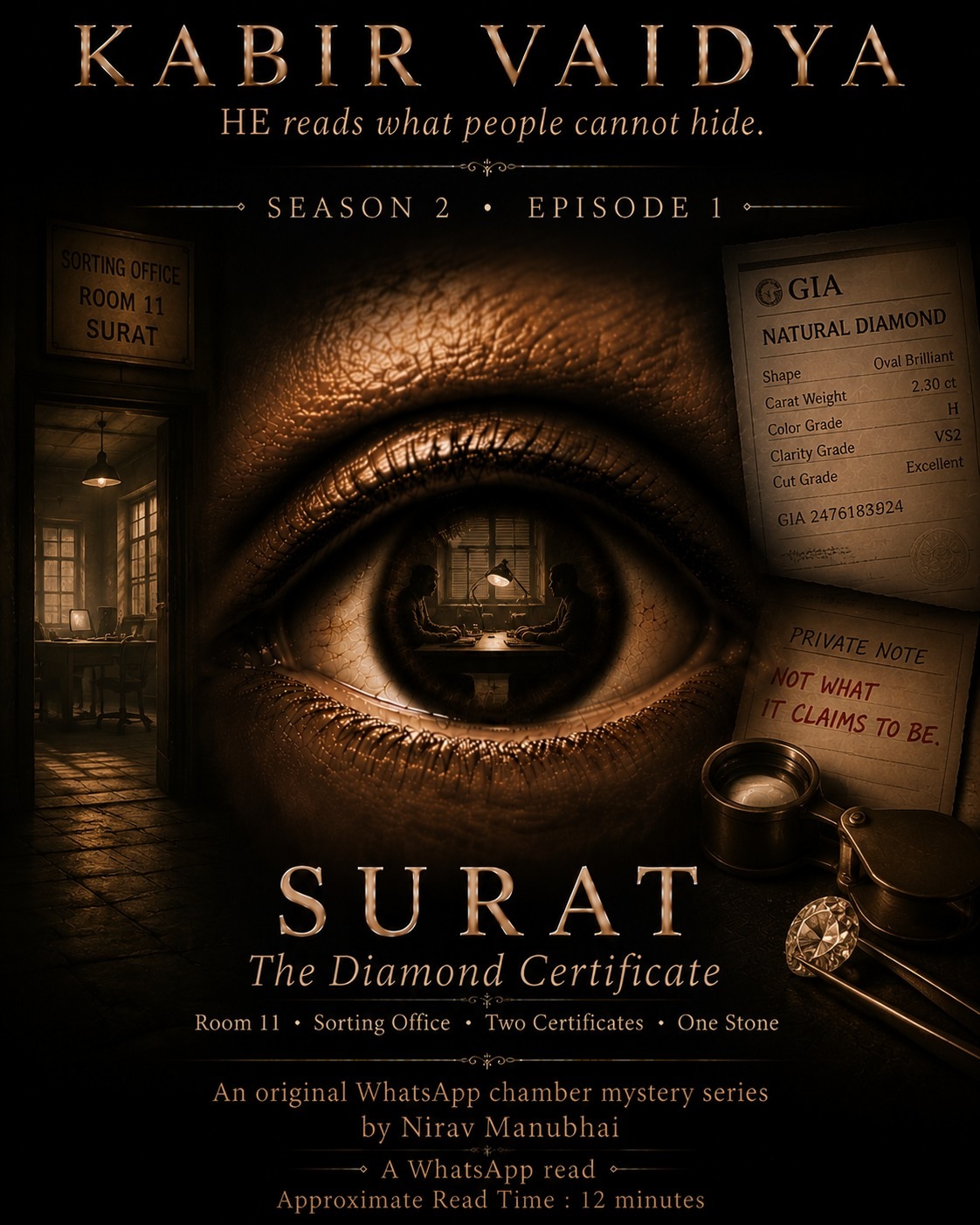
Season 2 begins. The body betrays the system.
Ten rooms taught Kabir to read the person in front of him. This room — and the nine after it — will teach him to read the machine standing behind the person. Same skill. Larger room.
THE CITY BEFORE THE ROOM
Surat arrives before you see it. The light does.
Gujarati noon light — sharp, golden, unforgiving. The kind of light that shows every impurity in a stone. Kabir has been in Surat twice before. Both times he left with the sensation that the city had read him, not the other way around.
Surat is a reader's city. Diamond traders read light the way poets read silence. And light, in Surat, is not decoration. It is evidence.
The sorting office sits on the second floor of a colonial building, the kind that remembers when cotton was power. The elevator smells of metal polish and something sharper — acetone, perhaps, or the ghost of cleaning solution. The walls of the corridor are cream. Everything in Surat is cream or gold or the colour of paper aged past usefulness.
Kabir's footsteps echo. The building knows he is coming.
ENTERING THE ROOM
The door opens inward. Cool air rushes past — air-conditioned to a precise temperature. Kabir enters a room that has been holding its breath.
The first thing is the light. The second thing is the smell.
The windows face north. North-facing light in Surat is the only light that doesn't lie. It pours across a desk, across papers, across two people sitting on either side of a loupe — positioned at the exact angle where the light will hit it perfectly. The fluorescent glare bounced off the white laminate. Kabir's eyes narrowed. The room was already interrogating him.
The loupe catches the light and throws it back, fractured, as if it has already begun to read what it has not yet examined.
The smell is a combination: expensive paper, the faint mineral scent of polished stone, and underneath, something else. Anxiety has a smell. It is similar to metal left in humid air. Oxidation. Breakdown.
The air-conditioning hums, but beneath that hum is silence. Surat's silence is different from other cities' silence. It is a silence that is listening. Two men in this room have not spoken in approximately four minutes. Kabir senses this from the way their bodies have arranged themselves — too still, too composed, like objects that have been placed and left alone.
The chair he is offered is leather, warm from the afternoon sun.
THE TWO MEN
Harshad Zaveri sits on the north side of the desk. Sixty-two years old.
The kind of face that has decided to be handsome through discipline rather than accident. His hands are on the desk. Not resting.
Positioned.
Resting implies relaxation. Positioned implies intention.
His left hand is flat, palm down. His right hand is flat, palm down.
Between them — approximately seven inches of clear space. The space itself is the point. His hands are declaring: I am not touching anything. I am not reaching for anything. I am keeping distance.
Rohan Zaveri sits across from him. Thirty-four. The face of someone who has spent his entire life trying to look like his father and simultaneously trying to look like someone who is not his father. He is losing the second battle.
His hands are in his lap. He is still enough that Kabir can see his shoulders breathing — a shallow, controlled breathing pattern that a person uses when they are trying not to cry. Not because of sadness.
Because of anger.
Between them sits the loupe. And on the marble surface of the desk, positioned exactly where the north light will hit it: a diamond.
THE OBJECT AND THE LIGHT
The diamond is 2.3 carats. Oval. Submitted to Zaveri Gem Lab as an untreated natural stone. The difference between an untreated stone and a treated one is not a few thousand rupees. It is enough to alter a sale, a family purchase, and the reputation of the laboratory whose seal appears on the report.
The report on the desk bears that seal. It says: Natural diamond. No treatment detected.
Beside it lies the printout from a second screening run. The trace rises where it should remain quiet — an anomaly consistent with high-pressure, high-temperature treatment. Under the loupe, Harshad can see faint surface graining that had been easy to dismiss the first time.
The loupe is not the verdict. It is the question. The instrument beside it has now asked the same question twice.
The light hits the stone and breaks into its component parts. The diamond becomes a tiny prism. Proof does not arrive beautifully. It simply arrives.
Harshad tracks the light path with the concentration of a man who has done this ten thousand times and has finally seen the one thing experience cannot make convenient.
WHAT KABIR READS IN THE BODY
Harshad's hands are not open. They are not closed. They are sealed — fingers curved inward, each hand holding only itself.
His breath is controlled: in through the nose, held, released slowly. It tells Kabir that control matters to him in this moment. It does not tell him why. Bodies are not dictionaries. A jaw, a blink, a held breath can mean several things. The room decides which meaning has earned belief.
Here, the hands matter because Harshad arranged the light, ordered the second screening, and placed the report between himself and his son. He created the conditions in which the truth could no longer remain accidental. Now his body is trying to contain the consequence of having done so.
THE HISTORY UNSPOKEN
Thirty-one years. Father and son.
Harshad trained Rohan to grade diamonds the way a jeweller trains an apprentice — through touch, through light, through the intuition that comes only from repeated exposure to stone.
They have graded together. They have documented together. They have signed reports together. And in thirty-one years, how many times? How many stones? How many documents?
Kabir does not ask this question. But both men in the room know that Kabir is asking it. The question hangs in the air like the dust motes the air-conditioning cannot quite eliminate.
The first time was probably an accommodation. A client arrived with a stone and a conclusion already formed. The first screening was uncertain. The report had nearly been prepared. Harshad chose the wording that would preserve the sale. What is the cost of one cautious sentence? What is the cost of disappointing a client who has already decided what the stone must be?
And then the second time. And the third time.
And then it became a system. Not a conspiracy. A system. A way of reading the world. The document says what the client wants the document to say.
Harshad built his reputation on light. And his reputation is built on a lie that was so small and so consistent that it became the thing people trusted him for. Not the honesty. The reliability. The fact that the document always confirmed what the client wanted to be true.
THE ROOM HOLDS ITS BREATH
Rohan's hands are shaking now. Slightly. Barely visible. But visible to Kabir, who is trained to see the slight tremor that indicates a person is about to either cry or scream or do something else entirely.
His jaw is clenched. The masseter muscle is contracted so hard you can see the outline of it moving under the skin.
His left wrist itched. The frayed threads of the Navratri wristband — still there, from October — scratched against his skin. He had forgotten to remove it. Or he had chosen to forget.
Rohan knows what the loupe is showing. He has known since before Kabir entered the room. He knew the moment the client handed over the stone and said: "Grade it. I need the report."
The client knew. The client suspected. The client paid for the suspicion to be erased by the document.
Harshad knew. Harshad has always known.
And Rohan has been trained to know. And Rohan has been trained to respond to knowing by not speaking. By letting the document speak. By positioning his hands in a certain way on the desk that signals: I am not part of this decision.
But his hands in his lap are making a decision. His hands are saying: I am removing myself. I am not staying for what comes next.
WHAT THE LIGHT REVEALS
The loupe alone cannot convict a stone. Harshad knows this better than anyone. So he runs the screening a third time.
The same warning appears.
The stone is natural, but its colour has been altered by a stable treatment that the report must disclose. The stone has not become worthless. The report has become false.
The correction can still be made before the stone leaves the laboratory.
A new report can be printed in minutes. What cannot be corrected in minutes is the pattern that made the wrong report feel ordinary.
On the desk, the two pages describe two different businesses. One sells certainty. The other sells whatever certainty the client has paid to receive.
THE MOMENT OF DECISION
Harshad's hand moves. Not his right hand. His left hand. The left hand — the hand of doubt, the hand of the unconscious — reaches for the loupe. His right hand remains still. His right hand is waiting to see what his left hand will do.
His left hand is centimetres from the loupe when Rohan stands. The motion is sudden. The chair — expensive leather, on wheels — rolls backward. It hit the wall with a sharp click. The wheel stopped spinning. The room waited.
Rohan does not look at Kabir. He looks at the diamond, then at the firm's seal, then at the pen beside his father's right hand — the same pen he has watched sign reports since childhood. His lips shape a sound he does not release. Kabir cannot be certain of the word. It might be Baba. Then Rohan walks out.
The door closes without being slammed. The control makes the sound worse. Harshad understands that the door may have closed on more than a meeting. A business can be inherited on paper long after the standard that made it worth inheriting has been refused.
Harshad's left hand completes its motion. He touches the loupe. He adjusts it. Very slightly. The angle changes. The light hitting the diamond changes. Everything changes based on millimetres.
He looks at the report. His right hand moves towards the pen Rohan had been watching — the pen that has signed every report for thirty-one years.
His hand pauses. The pen hovers approximately two millimetres above the signature line.
In the pause — the space between the decision and the action — Kabir reads what he will read in every room across this season. The moment when a system forces a person to choose between what they are and what they have become.
Harshad's breathing changes. His pupils dilate fully. His hands begin to shake.
And then — this is the tell that matters — his hands stop shaking.
They stop through an act of will so complete that the tremor is replaced by absolute stillness. The stillness of someone who has made a decision that they will carry for the rest of their life.
His hand moves. The pen touches paper. The signature is applied. Not rushed. Not slow. Applied with the precision of someone who has already said goodbye to the person they were before this moment.
THE K-NOTE
Room 11 · Surat A stone under controlled light. A report bearing a trusted seal. A son who left before his father signed.
The deception was not born in this room. What happened here was more final: Harshad saw the truth clearly, while there was still time to correct the page, and chose the page instead.
The body does not measure a lie by its market value. It measures the weight a person has agreed to carry — and the moment that weight becomes identity.
THE FORWARDABLE LINE
"A report can be corrected before it leaves the room.
The harder correction is the person who has learned to sign what the light disproves."
Next Saturday — Varanasi. A temple accounting room. A missing priest.
One pair of slippers nobody moved.
Kabir Vaidya will return.