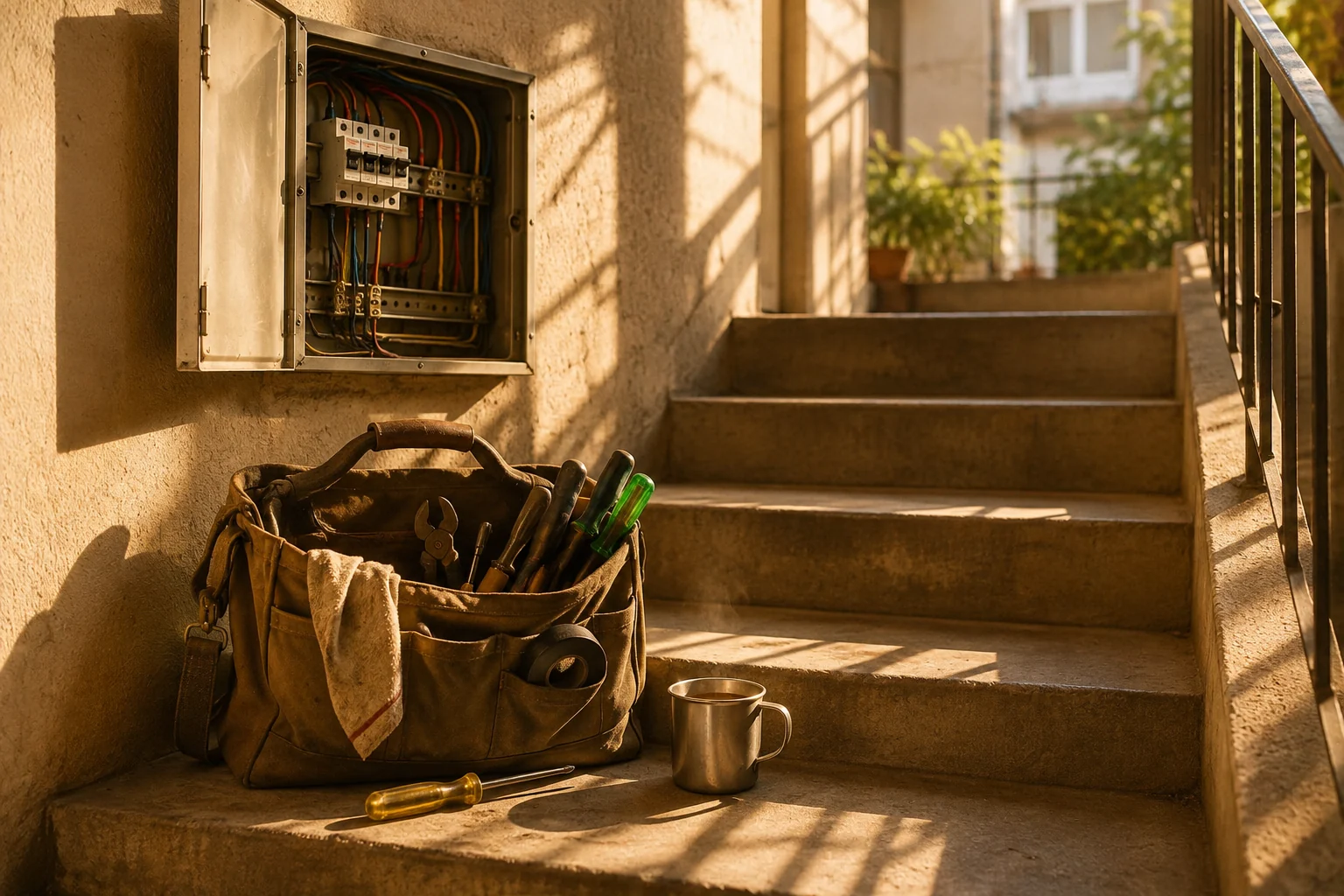
Ramu fixed things.
Not the way they do it nowadays — where you call a number, get a reference code, and wait for a technician who arrives sometime between your breakfast and your retirement. Ramu fixed things the way rain fixes a drought. He showed up. He looked at the broken thing. He fixed it.
Ceiling fan making a noise like a crow with a personal grudge? Ramu.
Geyser that heated water to exactly one degree above cold? Ramu.
Door that had swollen in the monsoon and now opened only if you lifted the handle, leaned with your left shoulder, and said something encouraging to it? Ramu had fixed that too — though he had charged extra, which everyone agreed was completely fair.
For twenty-two years he had been fixing things in the same four buildings of the same colony. He knew every pipe, every fuse box, every light switch that needed to be held down for three full seconds before it would agree to work. He knew which aunty would bring tea without being asked, and which aunty would stand behind him while he worked, watching so closely you could feel it on the back of your neck. He knew which uncle would explain — slowly, helpfully, in great detail — exactly how to do the thing Ramu had been doing since before that uncle had moved to this colony.
He was, in every real sense of the word, irreplaceable.
He was also, in every real sense of the word, a catastrophic businessman.
Nirav had known Ramu for eleven of those twenty-two years.
Nirav lived on the third floor, corner flat — the one with the water tank that made a sound like a ship in distress every time it filled. Ramu had fixed that sound four times. It always came back. By now this felt less like a plumbing problem and more like a long-running friendship.
In eleven years, Nirav had watched Ramu fix a washing machine with a hairpin. Rewire a short circuit using what appeared to be a piece of his own lunch. And once — this one Nirav still thought about — restore power to an entire floor by doing something to the main switchboard that took forty seconds and involved no tool that Nirav could identify. When Nirav asked what he had done, Ramu said adjusted it and moved on, which was either very simple or very profound and Nirav had never quite decided which.
He had also watched Ramu:
Forget to bill three jobs in a row because he got talking.
Bill a fourth job for less than the cost of the parts, because, as Ramu explained, the fellow looked like he was having a hard month.
Lend his only good screwdriver to a man in B Wing who moved to Surat and did not return it.
And once — this one Nirav treasured most — spend forty minutes fixing a neighbour's pressure cooker whistle for free, then quietly pay for the gas cylinder himself when it turned out she had run out, because, as Ramu said, what is the point of fixing the whistle if there is nothing to whistle about.
Nirav had, several times over eleven years, suggested that Ramu charge more. Keep a proper record. Get an assistant. Buy a second screwdriver, at the very minimum.
Ramu had listened to all of this with the expression of a man receiving a weather forecast for a city he did not live in.
Polite. Attentive. Completely unmoved.
One Tuesday — and it is always a Tuesday when the real things happen, have you noticed — Nirav came downstairs to find Ramu sitting on the bottom step. Not fixing anything. Not waiting for a call. Just sitting, the way a man sits when he has nowhere particular to be and has made a full and genuine peace with that.
Nirav sat beside him. This was not a decision. It was just what happened.
The colony moved around them. A scooter starting somewhere below. The smell of mustard seeds in hot oil drifting down from a kitchen on the first floor. A child being called in for lunch by a mother who had clearly moved, some time ago, from requesting to negotiating to something that was neither.
The step was cool and slightly dusty. The afternoon light came in sideways through the stairwell. A pigeon sat on the railing above them, doing nothing, which was at least honest.
After a while Ramu said — not to Nirav, not to anyone in particular, in the tone of a man making a small observation about the sky:
Bhai, I had a shop once. Did you know that?
Nirav did not know that.
My own shop. Electrical goods. Good corner — right at the signal on the main road. People had to stop there anyway because of the light. I thought — captive audience.
He said captive audience with the slight reverence of a man quoting something he had read once and believed completely.
What happened?
Ramu looked at the middle distance. A man who is about to tell a story he has not told in a while looks exactly like this.
First week. An old man came in — maybe seventy-five, very clean white shirt, the kind of white that takes effort. He needed one switch. Twenty rupees. He picked it up, put it down, picked it up again. So I asked him — Uncle, what is the matter. He said, actually I need three switches but today I only have enough for one. I said — take all three, pay when you can. He said, but I don't know when. I said — Uncle, I know which building you live in.
Nirav smiled.
He laughed. Took the switches. His grandson came the next week with the money and also a tin of chakli his wife had made.
Ramu paused.
Very good chakli. The thin kind, properly crisp.
So it worked out.
For him, yes. But by then I had already done the same for four other people. And told my brother, who also has this same problem of a good heart. And my brother told his wife.
Who did not share the policy.
She was not wrong.
Ramu said this with the warmth of a man who has had many years to arrive at a fair conclusion.
The shop closed in eight months. Not because of the credit. Because I am better at fixing things than selling them. Selling — you have to think about tomorrow, next month, next year. Fixing — there is only the broken thing in front of you and the moment when it works again.
No sadness in it. No complaint. Just a fact about himself, said clearly, by a man who had long since made friends with it.
A warm smell of ghee joined the mustard from upstairs. The pigeon rearranged itself on the railing, considered its options, and stayed.
Then from the lane below — a scooter that would not start.
One attempt. Two. The engine turning over and catching nothing, turning over again. The sound of a machine being asked to do something it was not sure it could manage today.
Nirav watched Ramu's head tilt. Just slightly. The way a doctor's head tilts in a corridor when something reaches them that has not been announced yet.
Fourth attempt. Fifth.
On the sixth, the engine caught. Held. Settled into its rhythm.
Ramu's head straightened. He said nothing. He had not been asked. But something in him had leaned toward that sound the way a plant leans toward a window — without deciding to, without even noticing.
Nirav sat with all of this for a moment.
Then he said — not because he had planned to, but because some things simply arrive and ask to be said:
Ramu. Do you know what you are?
Ramu looked at him with the mild suspicion of a man who has been told what he is before, mostly by people who wanted him to be something different.
You are the only person I know who has never once — in eleven years — fixed something and then stood around waiting to be thanked for it.
Ramu turned this over slowly. Looked at it from a few angles, the way he looks at a fuse box before opening it.
Why would I wait?
he said finally.
The thing is fixed. My part is done. What comes after is not my department.
He stood up.
From the second floor came the sound of a ceiling fan — a new sound, a complaint, the early suggestion of something that would become an emergency by evening if left alone. To anyone else it was background noise. To Ramu it was a name being called.
He picked up his bag.
Same time tomorrow?
said Nirav. This was a joke. Tomorrow Ramu would appear when something broke and not before.
Same time tomorrow,
said Ramu — who understood the joke perfectly and chose to answer it straight, which was funnier.
And he went up the stairs two at a time, bag over one shoulder, already somewhere else in his mind — already at the fan, already seeing what was wrong, already in the moment when it would work again.
Because that was the only thing that existed now.
The broken thing. And the moment it would work again.
Nirav sat on the step a little longer.
He was thinking about captive audiences. About shops that close in eight months. About a man who gives away his only good screwdriver and does not replace it and carries this as neither a wound nor a lesson — just as something that happened, the way weather happens.
He was thinking about what it means to be so completely, so simply yourself — that the space between what you believe and what you do is so small, there is no room left for doubt to stand in it.
He was thinking about his own shoes.
You know the ones.
Sitting exactly where you left them. Not judging — shoes do not judge — just waiting, with the patience of things that have nowhere else to be.
He was thinking: tomorrow.
And then, quietly, without drama, the way a ceiling fan starts after Ramu has fixed it —
The thing is fixed. My part is done. What comes after is not my department.
He stood up.
Picked up his bag.
Not tomorrow.
Now.
I Am. / હું છું.