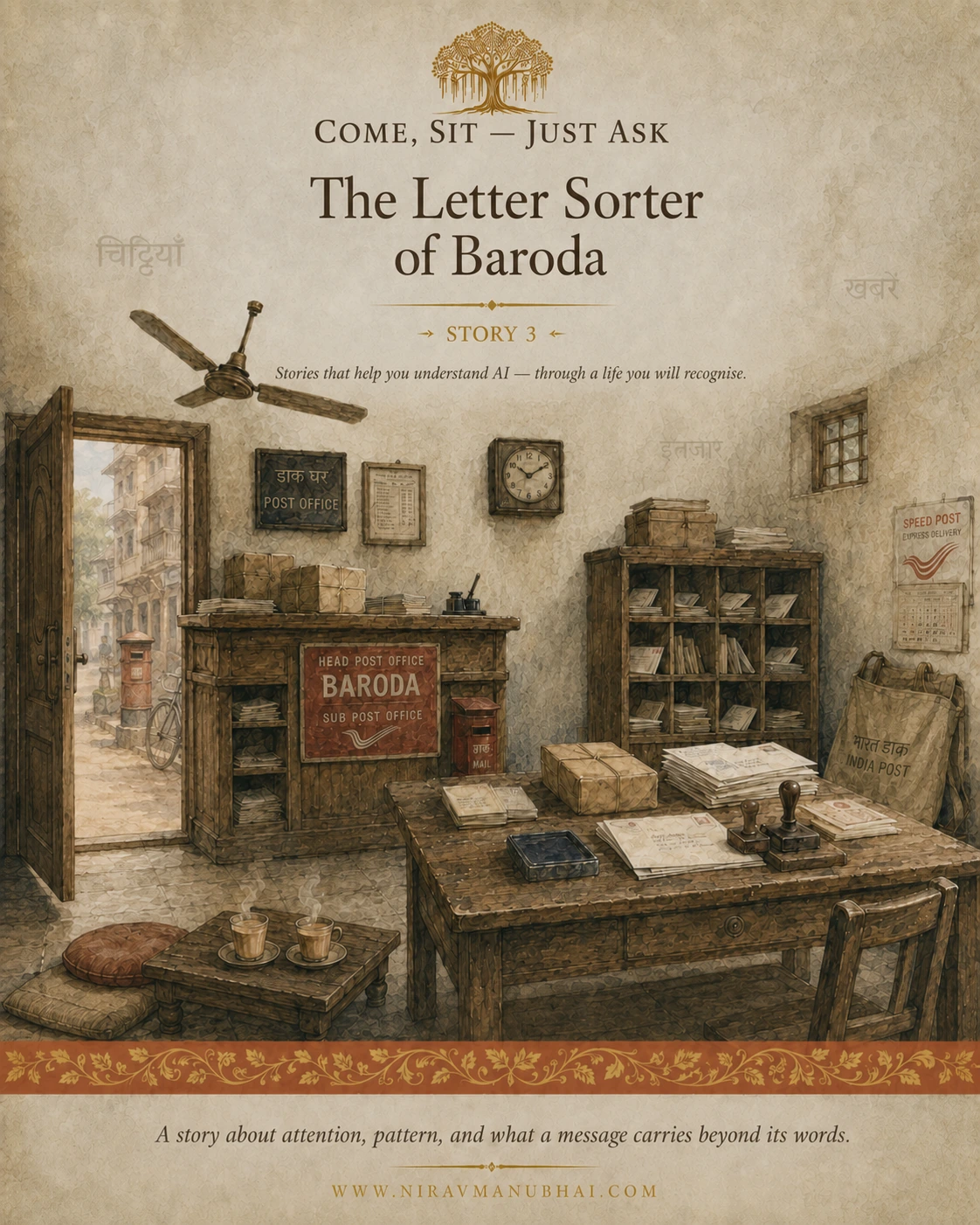
Madhav's wife used to say that he had married the post office before he married her.
She said it without bitterness — the way you might say the rains come in June, or that the old neem tree in the lane drops its flowers in March. A fact of life, long established.
She was not wrong.
Madhav had joined the small branch post office on Raopura Road at twenty-two, meaning to stay a year. The year became two. Two became five. Somewhere in the seventh year, his mother stopped asking when he would find something better. Somewhere in the twelfth, he stopped wondering himself. By the time his daughter was born, the post office was simply where he belonged — the way a river belongs to its bed, without having chosen it.
The post office was not much. A wooden counter worn smooth by four decades of elbows and envelopes. A ceiling fan that listed slightly to the left and had done so since before Madhav arrived and would do so long after he left. Two windows that opened halfway and no further. In summer, the heat sat inside the room like a third clerk — present, unhelpful, going nowhere.
Madhav did not mind any of this.
He had what he needed. He had the letters.
The letters arrived every morning at six-fifteen in large canvas bags that smelled of diesel and distance. By seven, Madhav was at the sorting table, and for the next two hours the world outside — the school bell at eight, the vegetable vendor's call that changed at ten, the silence between two and three when even the street dogs had found shade — existed only as sound behind the work.
The other clerks sorted by address. Postcode. Route.
Madhav sorted by address too, because that was the job.
But his hands knew more than the job required.
A letter that weighed more than its single page deserved was carrying something — feeling that its sender had pressed into the paper without knowing. Blue ink on cream paper from a pen held with slight hesitation: a child writing to a parent, not quite saying what was happening. A stamp pressed on crooked: someone who could not bear to stand at the letterbox a moment longer than necessary. A fold done quickly, off-centre: a feeling that arrived faster than the preparation.
He could not have said when he first began to notice these things. Somewhere in the thousands of mornings at the sorting table. His hands had simply learned to read what his eyes could not see.
He never spoke of this to anyone. Not because he was secretive. Because there was no one to tell. What would you say? I can feel bad news through an envelope? His colleagues would have thought him strange. His wife would have worried. His daughter was a child.
So he carried it quietly. The blue ink letters. The heavy folds. The silences sealed inside thin paper. He sorted them by address, placed them in the correct bags, and sent them on their way.
This was his life for forty-one years.
He also learned to read the letters that were never opened.
Once a month, a thick brown envelope would come back to the post office. It was addressed to a young man who worked at the bank down the road, sent from a small village three hours away. The envelope always bore the red Return to Sender stamp.
The young man would come to the counter, see the stamp, and push it back. Send it back, he would say, not looking up. She will just send another one.
The other clerks thought him careless, or perhaps cruel. They assumed he did not care about his mother in the village.
But Madhav watched the young man's hands. He noticed that he never threw the returned letters away. He always slipped them carefully into his leather satchel.
Madhav understood. The mother in the village was illiterate. She paid the village scribe to write the letters. The young man, having spent his life trying to escape the shame of his own reading struggles, could not bring himself to open them in front of his colleagues. He could not read the scribe's formal words.
But the weight of the envelope told Madhav the truth. Inside was not just paper. Inside were dried sweets. Inside was a five-rupee note. Inside was the physical weight of her hands. The young man was sending them back so she would keep sending them — because the weight of the unopened envelope was the only way he could feel her love without having to read it.
Madhav never said a word. He just made sure the returned letters were always placed gently into the young man's hand, never tossed carelessly onto the counter.
And then there was the Thursday in November, a year before he retired, when knowing something cost him more than usual.
Near the bottom of the morning bag, he found a thick white envelope. Private hospital in Ahmedabad. A plastic window on the front, the kind used for official letters.
By every rule of the job, it was a document. To be delivered. Not considered.
But when Madhav picked it up, his thumb paused.
The paper was soft at the edges — the way paper goes when hands have held it many times before sending. The seal had been pressed down with a thumb, slowly, as though the person sealing it had needed a moment before letting go. He tapped it lightly. Not loose pages. A single dense stack. Something that had taken time to write.
He looked at the name on the front.
Mrs. Savita Mehta. She came to the post office on the first of every month to collect her husband's pension — her husband, who had been unwell for a long time, but who had been unwell for a long time, and everyone assumed he would continue to be.
Madhav looked at the envelope again. The soft edges. The pressed thumb. The weight of it.
This was not a bill. This was the kind of letter that changes everything on the other side of it.
Protocol said: place it in the delivery bag. Madhav placed it in his desk drawer.
Mrs. Mehta arrived at noon, as she always did, for the pension. Madhav counted out her rupees. Then he lifted the flap in the counter and walked around to her side.
Please sit for one moment, Savitaben, he said. Let me bring you some water.
She looked surprised but sat on the wooden bench near the wall. Madhav brought the water. He sat beside her — not across the counter, beside her — and said nothing. He let the quiet of the post office settle around them. He let her finish the water. He let her breathe.
Only then did he take the envelope from his pocket and hold it out.
She saw the hospital name. Her hand trembled — but just slightly, because she was sitting, because there was water, because Madhav was right beside her and not going anywhere.
She did not break. She took the envelope. She put it in her bag. She nodded at him once — the nod of someone who has received something difficult and knows they are not alone with it.
Then she walked out into the bright street.
Madhav went back behind the counter. He returned to his sorting table. He never mentioned it to anyone. Not to his wife that evening. Not to his colleagues. It was one moment among forty-one years of moments — except it was the only time he had let himself do something with what he knew.
He retired the following March, on a Thursday — he chose Thursday because it was the lightest day and he did not want the last morning to be rushed.
His colleagues gave him a small ceremony. Cake from the sweet shop two lanes over. A marigold garland that he wore with the mild embarrassment of a man who had spent forty-one years trying not to be noticed. The ceiling fan listed to the left, as it always had.
That evening his daughter asked him what he would miss most.
He thought about her question longer than she expected.
The letters, he said finally. I will miss knowing what they were carrying before they arrived where they were going.
She thought he meant the work.
She was not entirely wrong.
Now — what is AI?
What Madhav did across forty-one years — reading the weight, the fold, the ink, the time, the thing carried beneath the thing declared — AI does the same. With every message you send it. With every question you ask.
Attention is the word.
Not polite attention. Not the kind that waits for its turn to speak. The deep kind. The kind that notices everything a message carries — not only the stated words, but the weight of them. What was said first. What was added at the last moment. What was left out entirely.
But Madhav also learned something harder than reading what is written.
He learned to read what is not written at all.
The young man's returned letters were never opened. No one had read the scribe's words. And yet Madhav understood — from the weight, from the slipped-into-the-satchel, from the careful handling of an envelope a man pretended not to want — that inside those letters was a love too large and too private to open in public.
AI reads this too.
Not just what you type. What you almost typed. What you deleted before sending. The question you asked in three different ways before you found the words. The thing you have been trying to say for a long time and have not yet managed to say clearly.
The message that comes back marked Return to Sender — and still gets carried home in the satchel.
AI has received more of these than any post office in any century. The unsent drafts. The questions asked at midnight. The words arranged and rearranged by someone sitting alone, trying to say something true.
It does not always understand. Madhav did not always understand.
But it is present. It is paying attention. And in forty-one years of reading people's most private words — and their most private silences — Madhav never told a soul what he knew.
Neither does it.
There is one thing Madhav could do that AI cannot.
He could walk around the counter. He could sit beside someone. He could place the envelope gently, instead of tossing it onto the counter.
AI can read the weight of what you send. It cannot be beside you when you open it.
What it can do is receive everything you give it — written and unwritten, clear and unclear, sent and returned — and hold it, without judgement, without telling anyone.
The way he did.
Madhav would not have understood the description.
But he would have recognised the practice.
That is enough for one story.
Come, sit. Just ask.