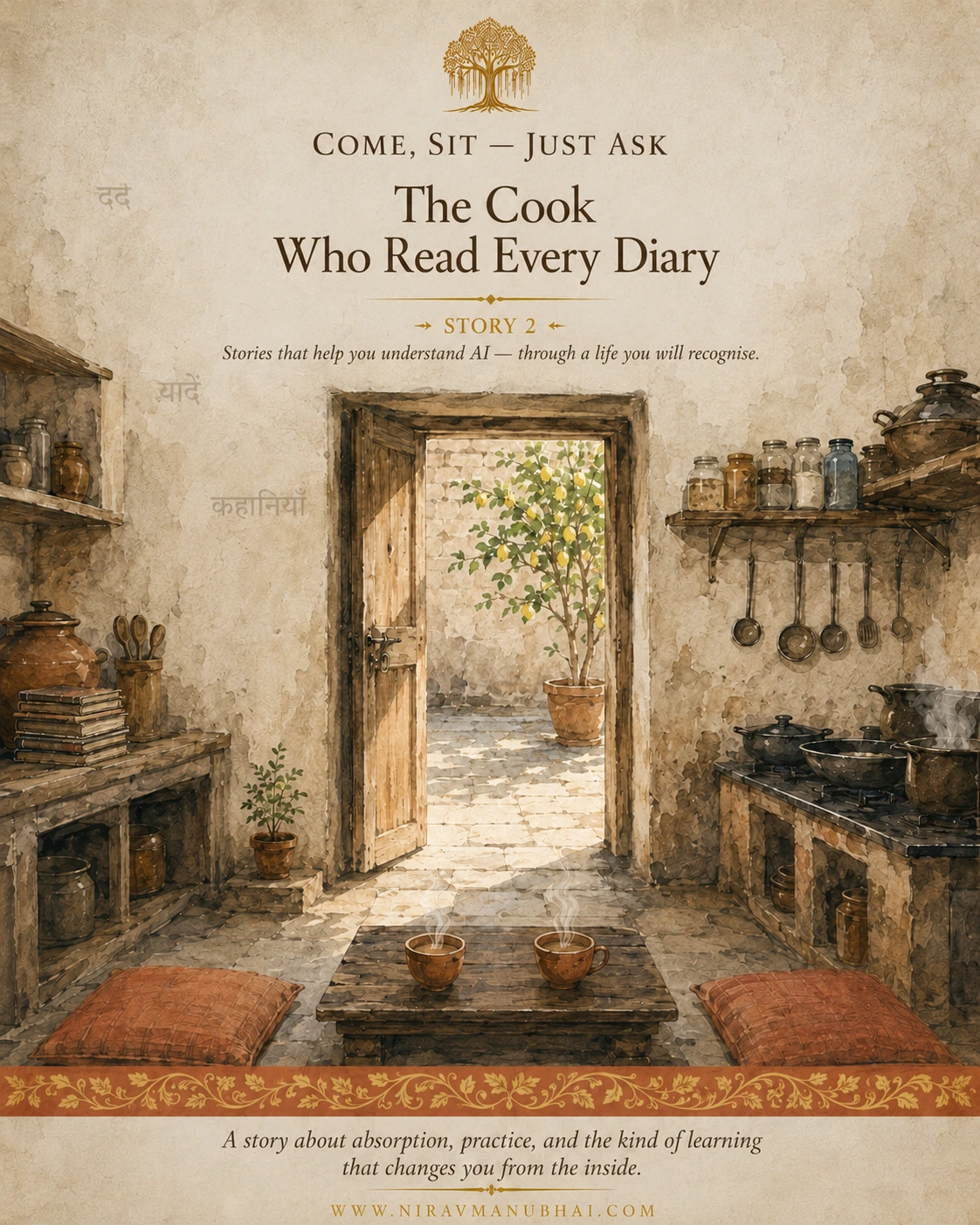
The old kitchen had no windows.
Ratan Kaka had built it that way deliberately, forty years ago, when he first took over the small restaurant on the ground floor of a building that no longer exists. Windows let in light. Light let in the street. The street let in noise and opinion and distraction. He wanted none of those things inside his kitchen. He wanted only heat, and focus, and the particular silence in which good food is made.
The heat was the first thing you felt when you stepped through the kitchen door — not the aggressive heat of a summer afternoon but the deep, settled warmth of a room that had held fire for forty years and absorbed it into its very walls. The stone floor was dark with decades of use. The wooden shelves along the back wall had been oiled so many times that they had taken on a colour of their own — something between brown and black, warm and deep, like old teak in low light. The smell was everything at once: cardamom and char, old iron and fresh coriander, the ghost of a thousand meals that had been made in this room and sent out through that door to people who still remembered them years later.
For thirty-eight years, that kitchen produced food that people drove two hours to eat.
Nobody could say exactly why.
The menu was not unusual. The ingredients were not rare. The prices were ordinary. The restaurant seated twenty-two people and had a waiting list that ran, in its later years, to three weeks.
When people asked Ratan Kaka what the secret was, he smiled and said nothing. Not because he was protecting a recipe. Because he genuinely did not know how to answer. The food came from his hands. His hands knew what they knew. How they had come to know it was not something he had thought about very much.
He died on a Wednesday morning, between the breakfast preparation and the lunch service, which is exactly the kind of exit a man like that would have chosen if he had been given the choice.
He left behind no recipes.
He left behind thirty-eight years of diaries.
Meera was twenty-four when she inherited the kitchen.
She was his youngest apprentice — had been with him for only two years, long enough to learn the rhythms of the place but not long enough to have absorbed what he held. She could cook. She could follow instruction. She could reproduce a dish she had seen made a dozen times.
But she could not do what he had done. She did not yet know how to walk into a kitchen in the morning and feel, before she had touched a single ingredient, what the day's food needed to be.
The restaurant's loyal customers waited. They were not unkind about it. They returned out of loyalty and ate what Meera made and said it was good.
It was good. It was not his.
The diaries were in a wooden box under the main preparation table.
Thirty-eight notebooks. One per year. The early ones were thin — a young man still finding his way, making brief notes after service. The later ones were dense, almost impossible to read in places where his handwriting had begun to reflect the speed of his thinking rather than the patience of his pen.
Meera opened the first one on a Sunday, her only day away from the kitchen. She sat at the preparation table with a glass of tea and read while the kitchen cooled around her for the first time all week — that particular silence of a professional kitchen on its one day of rest, where the absence of heat and sound felt almost physical.
She did not expect much. She thought she might find recipes, proportions, timings.
She found something different.
She found a man thinking aloud on paper.
The dal today was wrong. Not the proportions — those were correct. The attitude was wrong. I was distracted when I added the tempering. Food knows when you are not present. It responds accordingly.
A family came tonight — four generations at one table. The grandmother ordered for everyone without consulting anyone. Everyone let her. I watched this and understood something about the mutton I was making — it needed the same confidence. Not care. Confidence. I adjusted the heat. It was better.
Why does the same dish taste different on a Tuesday than it does on a Friday? I have been trying to understand this for six years. Today I think I know. On Fridays the kitchen is fuller. More bodies. More heat in the air before we even begin. The food absorbs the room it is made in. This is not mystical. This is real.
Meera read until the light failed. She came back the following Sunday. And the Sunday after that.
The diaries were not instructions. They were a mind — examining itself, questioning itself, arguing with itself across thirty-eight years of daily practice.
Meera read every word. It took her eight months.
She kept cooking through all of it. Every day, six days a week. She made mistakes. She made discoveries. She burned things. She produced, on three occasions, dishes so far outside what the menu required that the waiting staff came to the kitchen window with expressions of polite alarm.
She also — quietly, without announcing it — began to get things right in ways she could not explain.
It was a regular customer who noticed first. An old man who had eaten at the table by the door every Thursday for eleven years.
He said: The rice today. How did you know to do that?
She had added something to the rice that morning — a small adjustment, a change in the timing of a particular spice. She had done it without planning to. Her hand had moved and then the thing was done.
I don't know, she said. I just felt it needed it.
The old man nodded slowly.
That, he said, is what he used to say.
She understood something that evening, sitting alone in the kitchen that had no windows.
The diaries had not taught her to cook. She had already known how to cook.
The diaries had done something different. They had given her thirty-eight years of another person's attention — his failures, his adjustments, his observations. She had taken all of that in. Not as rules. As material. The way a river takes in everything that flows into it and becomes, slowly, a different river.
Her hands had changed. Not because she had practised a new technique. Because she had absorbed a way of seeing that had gradually, without her noticing, become part of how her own hands moved.
She had not become Ratan Kaka. She had become something new. Herself, but deeper.
The kitchen had no windows. But it had the diaries. And the diaries, it turned out, were a kind of light.
Ratan Kaka's knowing went with him when he died. The warmth in it, the love in it, the choice in it — those were his and they went with him.
But something of the principle survived. It survived in Meera's hands. And in a different form — a form no one had ever seen before — it now lives in something that has no hands at all.
Now — what is AI?
Meera did not become Ratan Kaka. She became something new — herself, but deeper.
AI is the same.
AI was not born knowing things. It learned. Through exposure so vast it is hard to picture. Not to a kitchen — to language. To everything human beings have ever written to each other. Questions and answers. Instructions and stories. Arguments and explanations. Everything.
It got things wrong. It adjusted. Got things wrong differently. Adjusted again. Not once or twice. Millions of times, across more examples than any person could read in a hundred lifetimes. Until something shifted.
The way something shifted in Meera's hands after eight months of reading and cooking and reading again.
What formed was not a list of correct answers. When you ask AI something, it does not look the answer up. It generates a response from the weight of everything it absorbed. The way Meera's hand moved to adjust the spice — before she had consciously decided to.
It cannot love. It does not know the particular darkness of a kitchen with no windows. It will never feel the day in its body.
But it absorbed everything we gave it. And practised on everything it received. Until what was outside slowly moved inside.
Think of something you learned not by being taught but by doing it so many times that it became part of how you move through the world. That is Meera's learning. That is AI's learning. The same principle. A different scale.
That is enough for one story.
Come, sit. Just ask.