Episode Six had one object near the door that nobody took. A blue bag. Small. A child's inhaler inside it. A red thread tied to the zip. The abductor had taken Diya but left the bag. Someone who knew her breathing knew she would not panic without the inhaler. He was right. He did not know what the red thread meant. The bag did not tell Kabir who had taken her. It told him what kind of person had. That is a different, and more useful, thing to know.
PART ONE · THE SUITE
The room smelled of sea salt, antiseptic, and something older than either — the particular weight of a decision deferred for thirty years.
Mumbai does not wait. It forces the choice, covers the coast in monsoon grey, and counts the consequences while you are still deciding. In this city, inheritance is not what you receive. It is what you survive.
Every Indian business family has a version of this room — the elder who built, the heirs who waited, the lawyer who knew too much, the document wrapped in respect until it became a weapon. Mumbai only gives such rooms a better view.
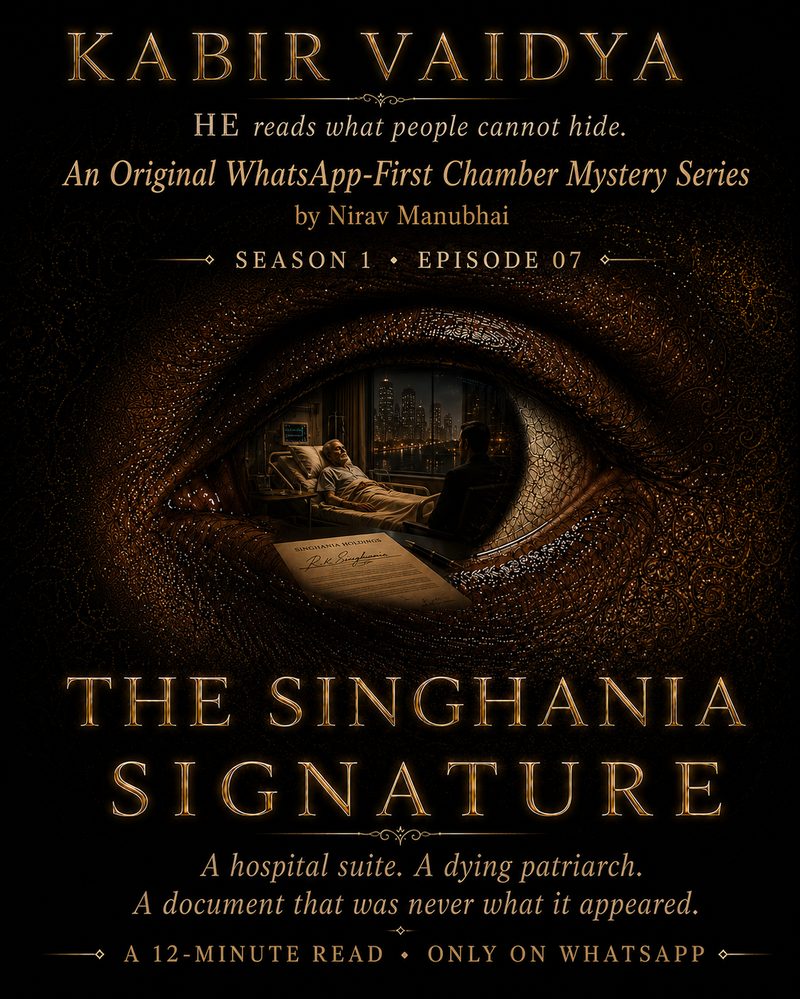
The suite was on the thirty-second floor of a private hospital in South Mumbai. Through the double-glazed window, the Arabian Sea was the colour of old pewter — the particular grey of mornings when large things are ending and nobody is ready.
The room was quiet in the way expensive rooms are quiet: not empty of sound but engineered against it. The only noise was the low, rhythmic hiss of an oxygen concentrator. It had been running for six days. Its rhythm had become the room's pulse.
Kabir sat in a low chair near the door. He had been there for nine minutes.
On the bed, propped against white pillows, lay Shashtri Singhania. Seventy-eight. The man who had built the docks, bought the politicians, and broken his own sons across three decades of careful, deliberate pressure. His eyes were closed. His breathing was shallow but controlled. He was conscious. He was choosing the silence of a man who had already decided what this morning would cost.
✦ On the bedside table, beside the oxygen concentrator, stood a small framed photograph. A younger Shashtri at the docks, 1994. Beside him, a boy of perhaps twelve, squinting into the light. Anand. Before the test had begun. Before either of them knew there was a test. ✦
Across from Kabir sat the brothers.
Anand Singhania, fifty-one. The elder. Tailored suit immaculate. But the knot of his tie was pulled three millimetres to the left — the microscopic concession of a man who had dressed in a hurry because he had not slept. Palms flat on his knees. Elbows tucked tight against his ribs.
Devendra Singhania, forty-six. The younger. Rolled sleeves. Thick wrists. His fingers locked together in his lap with a pressure that had turned the knuckles the colour of old wax. He had driven through the night from Pune. Three hundred and fifty kilometres of trying to decide what he was going to say when he arrived and arriving to find the words still unformed.
Between them, on the bedside table, lay a single sheet of paper. The restructuring document for Singhania Maritime. Three generations of ships, docks, and debt, reduced to two signatures on one page. The market opened at 9:15am. It was 7:40.
Anand spoke first. His voice had the smooth, friction-free quality of something rehearsed.
"The board approved the split. Legal has spent forty-eight hours on this. Devendra gets the logistics arm. I retain the shipping lines. Father signs before nine, the stock holds. He doesn't sign, the credit lines freeze and we lose everything."
Kabir did not look at Anand. He looked at Devendra. Devendra's breathing was trapped. Short and high in the chest, as if he could not allow himself a full breath without something breaking.
[ The vagus nerve — the calm wire — can restrict the diaphragm when betrayal is experienced alongside composure. The person breathes but does not breathe fully. Devendra was not just angry. He was mourning something he had not yet been told he had lost. The body always knows the news before the mind receives it. ]
"He won't sign. He knows what was done to the valuation. He knows the logistics numbers were adjusted."
Anand's face did not move. "The audit was independent. You are reacting with emotion. Father responds to survival, not emotion."
Kabir stood. He walked to the edge of the bed and looked down at the old man.
"Mr. Singhania. Your sons have brought you a document. But your body is holding something that is not on that page."
The old man's eyelids opened. Slowly. His eyes were clouded with age but the intelligence behind them had not softened. He did not look at Anand. He did not look at Devendra. He looked at Kabir with the directness of a man who had been waiting, for some time, for someone to say the right thing.
PART TWO · THE TELL
The old man's right hand lay on the white sheet. The fingers curved slightly toward the document.
"Sign," he whispered. Barely a sound. More vibration than word.
Anand's right hand moved toward his breast pocket. The Montblanc. The reflex of a man who had rehearsed this moment many times. But Kabir was watching Anand's left shoulder.
The moment the old man said the word, Anand's left trapezius hitched upward. Less than a centimetre. Barely visible.
[ An asymmetric shoulder hitch — one side rising while the other holds still — is the body initiating a partial flight reflex. It is not the response of a man receiving a victory. It is the response of a man narrowly surviving an exposure. Anand's body knew something his face had decided not to show. The body always files its report before the face has assembled its story. ]
"You don't want him to sign."
The oxygen concentrator hissed. The sea outside continued its indifferent pewter movement.
Anand's hand stopped halfway to his pocket. A short, dry laugh. "I built this deal. Six months preventing a hostile takeover. Why would I want him to refuse?" "I did not say you want him to refuse. I said you do not want him to sign. There is a difference."
Devendra stood. "Speak clearly. We have thirty minutes." "Look at your brother's throat."
Anand's hand had frozen entirely. His thyroid cartilage was moving — a series of rapid, involuntary swallows. The mouth goes dry under high-stakes deception. You cannot command the salivary glands to continue their work when the brain has classified the moment as survival-level threat.
"You filed a secondary injunction. Yesterday afternoon. Before 5pm."
The silence that arrived had weight.
Anand's face did not shatter. It hardened.
"The restructuring document on this table is a mechanism. If your father signs it, his signature activates a clause in the injunction — a clause referencing a family trust condition from 1994. Once activated, it invalidates Devendra's share entirely. A silent trigger. Built into the document that looks like protection.
On ordinary paper, it looked like protection.
In the right hands, at the right moment, it became a knife.
You are not here for a split. You are here for everything. And you need his signature on this specific page to release the trap."
Devendra looked at his brother. Something left his face that did not come back. "Tell me he is wrong, Anand."
Anand did not look at his brother. He looked at Kabir. "You read bodies, Vaidya. You do not read courts." "I do not need to read courts. I read the man who writes the lie. Your left hand has been in your pocket for the last eight minutes. Your thumb is pressing the remote lock button on your car keys. Repeatedly. Your body has already left this room. You are already in the car. You are already gone."
PART THREE · THE PATRIARCH
The old man on the bed made a sound. Not a breath. Not a word. Something older than both — the sound of a man who has been carrying a specific weight for a very long time and has finally, in the presence of the right witness, set it down.
He turned his head toward Anand. Slowly. The IV line pulled taut. He raised his right hand. Not toward the document. Toward his son. One finger extended. Trembling at the tip but absolute in its direction.
"I knew."
Anand's mask cracked. Not all at once. In one place — the inner corners of the eyebrows drawing together and upward. The expression the face cannot suppress when everything else is under control.
"Father—"
"I knew."
The old man's voice was the sound of dry leaves on stone. "The 1994 clause. I left it there. For you. I wanted to see whether you would use it."
Devendra sat back down. Heavily. Not because he had lost but because the room had revealed itself to be something none of them had believed they were in. A thirty-year examination, conducted in the architecture of ships and docks and trust documents, finally arriving at its result.
"Then there is nothing to sign." His voice was very flat. The flatness of a man who has reached the bottom of something and found only more bottom. "Let it open."
Kabir walked to the table. He picked up the single sheet of paper. He held it for a moment — the weight of three generations in eighty grams of legal paper — and tore it once, cleanly, down the centre.
Neither brother moved. The old man's eyes closed again. Kabir placed the two halves back on the table, side by side.
The sound was the loudest thing in the room.
Not because paper is loud.
Because everyone in the room knew what had really torn.
"The market will open. The credit lines will freeze. Everything your father built will enter a process it may not survive." He looked at both of them. "But this morning, for the first time, you are in this room as his sons. Not as his heirs. That is something."
He turned toward the door.
PART FOUR · WHAT THE ROOM KNEW
He stood at the door with his hand on the frame and let the room speak its residue.
The oxygen concentrator hissing. The sea outside, indifferent. The two halves of the document on the table. The old man's breathing, which had become — in the last few minutes — slightly deeper.
There was one more sound now: the old man's thumb moving once across the bedsheet, as if counting an invisible mala. Not religiously. Habitually. The body returning to a rhythm older than wealth, older than signatures, older than the family name on the building.
Anand had not moved. Devendra had his face in his hands. Shashtri Singhania's right hand lay open on the white sheet. The palm was upward now. Empty. The gesture of a man who had released something he had been holding since 1994.
Kabir thought about the 1994 photograph on the bedside table. The boy of twelve, squinting into the light. Anand before the test had begun. Before either of them knew there was a test. The patriarch had looked at that photograph every morning for thirty years. Perhaps asking the same question every morning: is today the day he reaches for it? And the morning had finally arrived.
[ The insular cortex — buried deep in the brain — processes what researchers call interoception: the body's awareness of its own internal state. It registers moral discomfort as physical sensation. In people who have spent decades suppressing this signal, its release produces something that looks like exhaustion but is not. It is the body finally being allowed to tell the truth. Shashtri Singhania's breathing had deepened the moment the paper tore. His insular cortex had been waiting thirty years for that sound. ]
PART FIVE · WHAT REMAINS
He took the stairs down. All thirty-two floors. He needed the descent — the physical movement down through the building, through the thirty-two layers of other rooms, other silences, other families holding documents they should have torn years ago.
On the nineteenth floor he stopped.
He thought about Anand. Intelligent enough to find a clause in a thirty-year-old trust document. Not intelligent enough to understand that the clause had been left there as a test, not a tool. The tragedy of a certain kind of ambition is that it cannot distinguish between a gift and a trap. It reaches for both with the same hand.
He thought about Devendra. Who had driven through the night from Pune. Who had come not to claim anything but to prevent a theft — and had discovered that the house itself had been built around the expectation of exactly this theft.
He thought about Shashtri. Who had said I knew. Who had built a labyrinth and spent thirty years waiting for someone to navigate it correctly. And who had, this morning, received the answer he had been waiting for — which was also the answer he had most feared. Because a patriarch who builds a test is always, secretly, hoping to be proved wrong.
He typed to K:
Room 07 · Mumbai. The tell was the shoulder. One centimetre. The body responding to the father's word before the face had decided what to do with it. A man who has spent thirty years building toward a moment still flinches when the moment arrives. The body knows the cost of what it is doing. Always. Even when the mind has convinced itself otherwise. I keep thinking about the mala. A dying man in a hospital room with thirty years of a question finally answered, and his body returns to the oldest rhythm it knows. Not prayer. Habit. There are people in these rooms who carry without being asked. I am only beginning to notice them.
On the fourteenth floor landing his phone buzzed. Maya. She had found the name behind the name in the Delhi injunction. The person Parashar had been protecting with the moved clock. And it was not who either of them had expected.
Kabir typed one word back to Maya. Coming.
He continued down the stairs. Mumbai waited outside — grey, vast, indifferent to inheritance. The sea would be the same colour when he left as when he arrived.
The body does not lie. It only inherits.
One sound in this room will stay with you.
Not a word. Not a confession.
The sound a document makes when it finally tells the truth.
If you heard it — you were in the room at the right moment.
Next — Kolkata. A crumbling library. A sold manuscript. An intellectual alibi.
Kabir Vaidya will return.