Episode Three had one object the board forgot to clear. A chipped white cup with old tea stains near the rim. Still on the side cabinet. Still waiting. The company processed Mehrotra's resignation in two hours. Sent the announcement to the press in three. Nobody touched the cup. Which tells you something about what the board understood and what it did not. You can resign a man's title in an afternoon. You cannot resign thirty years of morning tea.
PART ONE · THE VANITY ROOM
The room smelled of sandalwood, cold powder, and a particular kind of loneliness that only the very famous know.
Chennai does not worship quietly. It builds height for its gods. Thirty-foot banners. Sixty-foot cut-outs. Milk poured over vinyl faces at sunrise. The love is real. That is what makes it dangerous.
Every Indian city understands this in its own language — a garlanded photograph in a shop, a birthday poster across a junction, a cut-out before a release, a leader made taller than the road that holds him. Ahmedabad has seen it. Mumbai has seen it. Chennai simply says the quiet part at full volume.
Kabir had been in Chennai for seventeen minutes.
The vanity room was behind the stage of an old auditorium near T. Nagar. Outside, twenty thousand people waited. Inside, four people sat around a man who had not spoken in ninety-four minutes.
Arul Vetrivel. Sixty-three. Film legend. Three hundred and twelve films. Forty-one years of being called Thalaivan by men who had never met him and would have died insisting they knew him. Tonight he was supposed to announce his formal entry into politics.
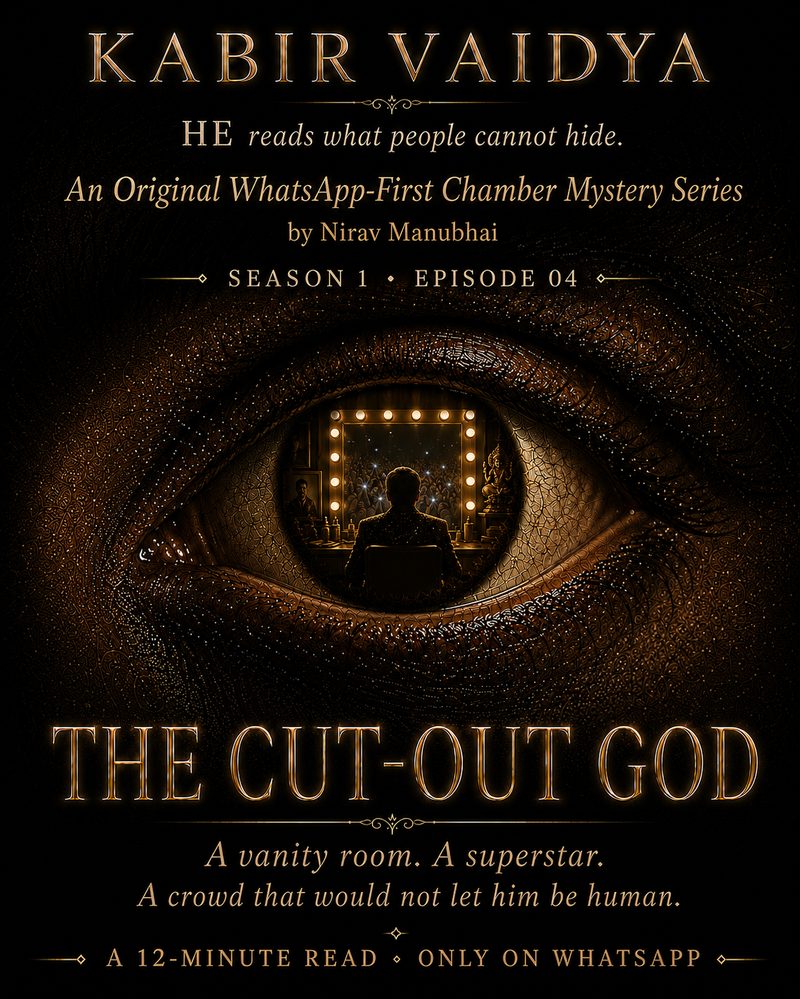
He sat before a mirror surrounded by round yellow bulbs. The mirror was large, old, merciless. It had reflected younger versions of him for decades — hero, saviour, rebel, father, god. Tonight it reflected a tired man in a white shirt, a veshti folded with too much care, sandalwood paste still wet on his forehead.
He had not looked into the mirror once.
Kabir noticed that first. Not the silence. Not the crowd outside. Not the fear in the room. The mirror. A man who had spent forty years being looked at was refusing to look at himself.
The others were:
Meera Vetrivel, thirty-six. His daughter. She sat closest to him, one hand on the armrest of his chair, not touching him. The hand wanted to. The mind had forbidden it.
Prakash Menon, forty-nine. Political strategist. White linen shirt. His phone lay face down on the table. Screen off. Too deliberately off. A strategist who has switched off his information source has already made a calculation he does not want interrupted.
Selvam, fifty-four. President of the All Tamil Arul Fans Federation. White shirt with Arul's face printed over the heart. He stood near the door because sitting would have required admitting he belonged inside this room and not outside with the crowd.
Kabir stood near the far wall. He did not sit. In some rooms, sitting made the room relax. This room needed to remain exactly as tense as it was.
"What happened?"
Prakash answered first.
"Sir is overwhelmed. The crowd. The pressure. This is a historic night."
"That is not an answer. That is a press release."
Meera's mouth tightened. Selvam looked at the floor.
Kabir looked at Arul.
The superstar's hands were folded in his lap. Perfectly still. Too still.
[ Perfect stillness is not peace. Peace has softness. This had force. The prefrontal cortex — the control desk — was restraining the body from doing what it wanted to do. The truth does not disappear. It relocates. Into the throat. Into the jaw. Into the eyes that refuse the mirror. ]
Outside, the crowd roared. One word, twenty thousand voices.
Arul! Then again. Arul!
"What are they calling him?"
Selvam answered softly. "God."
Kabir looked at Arul Vetrivel. This time the throat moved. Not toward the sound. Toward the window.
Beyond the half-drawn curtain, above the compound wall, visible over the crowd: a seventy-foot cut-out of Arul Vetrivel. Younger. Stronger. Chin lifted. Hand raised in blessing. A god made of flex, bamboo, rope, and labour.
Arul looked at it for one second. Then looked away.
Kabir understood then. Not everything. Enough.
PART TWO · THE CUT-OUT
"What happened at the cut-out?"
The silence arrived too quickly. Prepared silence. The silence of people who had already discussed this and decided where the walls would be.
Kabir turned to Selvam. "You were there this morning."
Selvam's hands came together. Not prayer. Defence.
"Ayya, small issue only. Morning setup. One boy fell. He is in hospital."
"Name."
Selvam blinked.
"Name."
"Murugan."
"Age."
"Twenty."
"Alive?"
Selvam's hands pressed harder. The room did not breathe.
Kabir looked at Prakash. "Alive?"
"There are conflicting reports."
"Bodies do not give conflicting reports. People do."
Meera closed her eyes. That was the first true thing she had done since he entered.
[ The larynx — the voice gate — can close under acute conflict. Silence is not absence. It is containment. Arul had not lost his voice. He had refused to use it until someone said the true thing out loud. ]
Kabir walked to the window. Pulled the curtain open. The cut-out filled the glass. Arul Vetrivel, twenty-five years younger, smiling at a city that had agreed never to let him become old.
He turned. "The boy is dead."
Meera looked at the floor. Selvam whispered, "At 10:40 in the morning."
Outside, the chant rose again. Arul! Arul! Arul! The dead boy had probably chanted it too. Since before he could read.
The first object that entered the room was not a file. It was a laminated photograph, still damp at one corner where milk had dried into a white crescent. Selvam had brought it in his pocket and forgotten that grief makes pockets heavy.
Kabir held it by the edge. Arul Vetrivel, twenty-five years younger, smiling from behind cheap plastic. On the back, in blue ink: First day. First show. First blessing.
Murugan had carried his god close to his chest. The god now sat in the same room and would not look at a mirror.
"When did he find out?"
Meera answered. "Forty minutes ago. I told him."
Prakash turned sharply. "You were told not to."
She did not look at him. "He is my father."
"He is also the face of a movement."
Kabir looked at Prakash. "There it is. The sentence everyone in this room has been trying not to say. He stopped being a man somewhere between the first poster and the first vote."
"With respect, Mr. Vaidya, you do not understand Tamil Nadu politics."
"With respect, Mr. Menon, I understand rooms. This one is full of people who need a god to walk on stage because a man would refuse."
The vanity bulbs hummed. Arul still did not speak. But his eyes had moved. Not to the cut-out. To Selvam.
PART THREE · THE FAN
Kabir turned to Selvam. "You climbed it."
"What?"
"The cut-out. After the boy fell. You climbed it."
"No." Too fast.
Kabir looked at his hands. Rough palms. Dust under the nails. A scrape near the right wrist. Rope burn between thumb and forefinger — the specific burn of sisal rope, not handrail, not ladder. "You climbed it."
Selvam's breathing changed. Small, shallow. Not fear of being caught. Fear of remembering.
[ Memory does not return as a file. It returns as weather. Breath changes first. Selvam was not deciding whether to tell the truth. He was already back on the bamboo frame, looking down at the boy. ]
"I went up after. To remove the loose rope. Before police came. Before media came. I thought if people saw, if video came, the programme would stop."
"So Murugan fell. You climbed up. Removed the rope. Changed the scene."
"I did not mean—"
"You did not mean anything. That is the problem with worship. It gives people permission to stop meaning and start obeying."
Selvam's eyes filled. "He loved Ayya. He came from Villupuram last night. No sleep. He said he wanted to tie the first garland before sunrise. He was laughing. Then the bamboo shifted."
His voice broke. Outside, the drums began. The opening act. Twenty minutes. Maybe less.
Kabir looked at Prakash. "You knew."
"I knew there had been an incident."
"Did you know he died?"
"Not officially."
"Not officially is the most useful form of knowing. It allows action without accountability."
Prakash stood. "We have twenty thousand people outside. One unfortunate accident cannot be allowed to destroy—"
"Say his name."
Prakash stopped.
"The boy whose death you are calling one unfortunate accident. Say his name."
No answer. The phone on the table — still face down. Still off. A strategist who had decided the information had already done its damage.
Meera said it quietly. "Murugan."
Something shifted in the room. Not enough to change the world. Enough to change the room.
✦ Outside the south gate, one woman was not chanting.
She had not come to see a god.
She had come for her son. ✦
PART FOUR · THE GOD DECIDES
Kabir walked to Arul Vetrivel and sat beside him.
Before he sat, he placed Murugan's laminated photograph on the dressing table. Between the mirror and the bulbs. Not in front. Beside. He did not look at the superstar. He looked at the mirror with him.
For the first time, Arul had no choice but to see himself reflected with someone else. Not alone. Not god. Man beside man.
"They need you to be larger than what happened."
Arul's eyes stayed on the mirror.
"But you are not larger than what happened. Nobody is."
The throat moved. A sound came. Not a word. A wound trying to become one.
Outside the chant reached the room. Thalaivan! Thalaivan!
Arul closed his eyes. When he opened them he looked straight into the mirror. Finally. Directly. The first time in ninety-four minutes. What he saw there was not the god. It was a sixty-three-year-old man who had spent forty years allowing other people to need him to be something he was not.
His voice arrived like something dragged from a deep well.
"I told them no cut-outs. Three weeks ago. No more tall structures. No more boys climbing bamboo for my face."
He looked at Selvam. "You were there."
"Yes, Ayya."
Kabir looked at Prakash. "You overruled him."
Prakash did not answer. His phone lit up on the table. He did not touch it.
"Murugan's mother is outside."
She had come with his college ID in a plastic pouch, his bus ticket folded into it, and one packet of vibhuti wrapped in newspaper. The kind of small inventory with which Indian mothers travel when they do not yet know whether they are going to a hospital, a police station, or a body.
Meera reached for the phone before Prakash could stop her. Read the message. Her face changed.
"She is at the south gate. Media is noticing."
Arul Vetrivel stood. Slowly. Like an old man, because that is what he was. Meera steadied him. He allowed it.
Prakash moved toward him. "Sir, please. One speech. The prepared speech. Then we manage this privately—"
Arul turned. One second. The old hero surfacing. Not the cinema hero. The man beneath him.
"No."
One word. The room changed around it.
PART FIVE · WHAT REMAINS
He went on stage nine minutes later. No music. No entry track. No fireworks. Just a tired man walking into light.
Kabir stayed in the wings. He did not need to see the crowd. He needed to hear what a god sounded like when he decided to become human in public.
Arul Vetrivel stood before twenty thousand people and said nothing for six seconds. The crowd loved even that — silence from a god is also interpreted as grace.
Then:
"My name is Arul Vetrivel. I am not god. I am an actor. I am a man. Today, because of my face, because of my banner, because of the madness we have all allowed, a young man named Murugan is dead."
A sound moved through the crowd. Not roar. Not silence. Something between shock and shame.
"His mother is outside. Before I ask for your vote, I will go to her."
Selvam folded to the floor and touched his forehead to the stage wing. Meera cried without covering her face. Prakash closed his eyes. His phone, still face down on the table inside, was receiving messages nobody would read for the next hour.
"No more cut-outs taller than a man. No more milk on my face when there are children who need milk at home. No more boys climbing bamboo to prove love. If you love me — stay alive."
For the first time that evening, the crowd did not know what to do with love.
The silence that followed was complete. Not empty. Full.
[ Worship is a dangerous arrangement because it divides the human being into two unequal parts — the image and the body. The image does not age, does not bleed, does not hesitate. The body does all three. When a person begins to live entirely as image, the body becomes the last remaining witness. It records the cost. It tightens the throat. It refuses the mirror. It waits for the moment when the man can no longer afford the god. ]
Kabir left before the speech ended.
His phone buzzed as the car moved through the back lane behind the auditorium. Posters on compound walls. Arul smiling. Arul pointing. Arul blessing. A boy had died so one of those faces could rise higher into the Chennai sky.
The message was from Maya. Two words. Parashar moved.
Kabir looked out at the city. Then placed the phone face down.
The room remained inside him. The mirror that had finally shown a man instead of a god. The cut-out still standing above the compound wall, smiling at a city that had just been asked to stop. Murugan's photograph under the bulbs — damp at one corner, the milk still not entirely dry. The mother at the gate. A crowd learning, for six seconds, what silence could contain.
He typed to K:
Room 04 · Chennai. The tell was the mirror. Ninety-four minutes of refusal. A man does not avoid his own reflection unless the reflection has been telling him something he cannot answer. The crowd called him god. The mirror only called him sixty-three. I am beginning to wonder which rooms I am solving and which rooms are solving me.
He sent it. Blue ticks.
The body does not lie. It only refuses.
One object in this room had already been to the temple before the god arrived.
If you found it — you understood why the mirror stayed empty for ninety-four minutes.
Next — Haryana. A window with bars. A woman who refused. A file nobody asked for.
Kabir Vaidya will return.