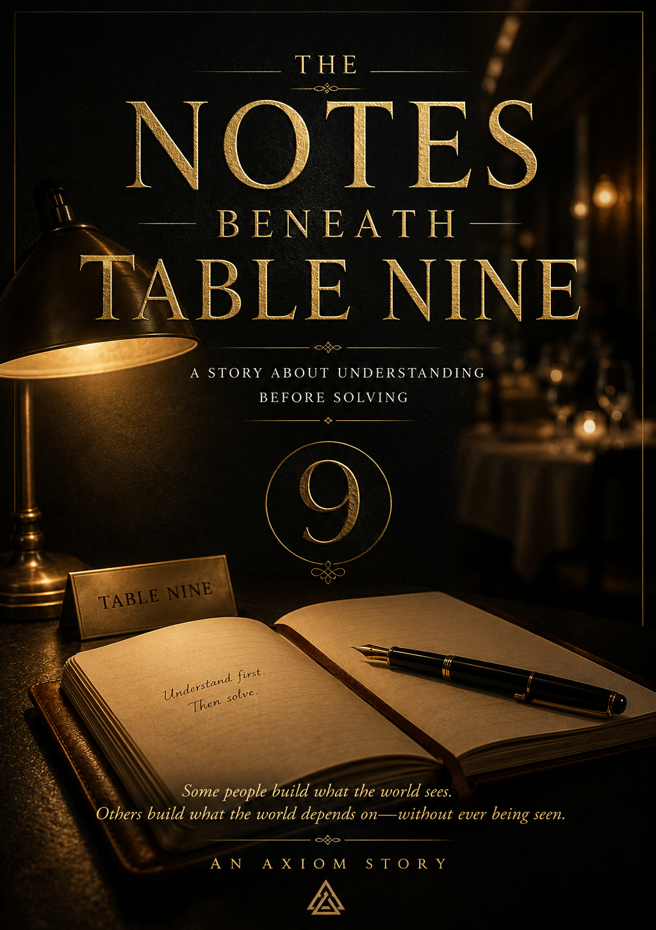
For every engineer who has ever made something invisible work perfectly.
The Reservation
There is a particular kind of excellence that the world never applauds. Not because it is unworthy. But because its highest achievement is to remain invisible.
There are restaurants that become famous because they serve extraordinary food. There are restaurants that become famous because famous people eat there. And then, once in a generation, there is a restaurant that becomes famous for a reason nobody can quite explain.
The Maison d'Or stood at the end of a quiet street where even the traffic seemed reluctant to interrupt the evening. It had no grand entrance. No sign announcing awards. No wall displaying photographs with celebrities. The brass handle on its old oak door carried the gentle wear of thousands of grateful hands.
Every evening, exactly forty guests crossed that doorway. Never forty-one. Never thirty-nine. The waiting list stretched close to eleven months. People travelled from Tokyo, São Paulo, Zurich, Singapore and San Francisco. Not because they had heard the food was the best. Because those who had eaten there struggled to describe what had happened. "It felt as though the restaurant had somehow prepared for me… rather than my reservation." That sentence puzzled critics for years. Prepared for me. Not my reservation. There was a difference. Nobody knew what it meant.
The kitchen was a masterpiece of organised precision. Every cook knew exactly where to stand. Every saucepan had a designated position. Every knife had a shadow marked beneath it. Every movement had been refined through repetition until it resembled choreography more than labour. The Executive Chef, Marcel, disliked improvisation. "Creativity," he often said, "is earned through discipline." Yet Marcel often reminded young apprentices of something that sounded almost insulting. "None of you are the reason people return."
The apprentices assumed it was false modesty. Until they noticed something curious. Every evening — before anyone entered the dining room, before the first flame was lit, before the first loaf emerged from the oven — Marcel removed his apron, walked straight through the kitchen, and disappeared into a small alcove where a single table waited beneath a brass reading lamp. Table Nine. He never sat there. Someone else did.
His name appeared nowhere. The payroll called him "Guest Liaison." The younger staff called him "the Listener." The older staff simply called him "Table Nine." Nobody remembered when he had first arrived. He seemed to have always been there. He wore the same charcoal suit every evening. Never hurried. Never raised his voice. Never interrupted. His notebook was bound in dark leather. Its pages had no lines.
Guests arrived one by one. Instead of being escorted to their tables, they were first invited to sit opposite him. The conversations were unremarkable — what brings you here, have you visited before, what sort of evening are you hoping for — and people answered politely. Many assumed they were merely being welcomed. After all, what importance could such a conversation possibly have? The kitchen had not yet begun cooking. No orders had been taken. No menus had been chosen.
One Tuesday evening a distinguished gentleman entered carrying the quiet confidence of someone accustomed to being recognised. His suit had no visible logo. His watch attracted no attention. He sat opposite Table Nine. "What brings you here?" asked the Listener. "I've heard this is the finest restaurant in Europe." "And what does 'finest' mean to you?" The gentleman smiled. "Consistency." The Listener nodded. Nothing more. One sentence appeared inside the notebook.
The following evening a young couple arrived, holding hands so tightly the maître d' wondered whether they might lose circulation before the first course. "We've just started a company. We promised each other — if we survived our first year — we'd celebrate somewhere unforgettable." "What would make tonight unforgettable?" The young man answered immediately: "The food." The young woman quietly shook her head. "No. We've had enough uncertainty this year. Just… let everything go right." The Listener wrote another sentence.
A week later an elderly woman arrived alone. She carried a worn paperback inside her handbag. Its pages had yellowed from decades of reading. "What brings you here?" "My husband. He passed away three years ago. We celebrated every anniversary in a different restaurant. This would've been our forty-seventh." The Listener gently closed the menu. "I don't think you'll need this." She smiled through unexpectedly moist eyes. Neither of them mentioned food again.
The remarkable thing was this: guests rarely remembered the courses. They remembered moments. The waiter who arrived exactly when a conversation had ended. The dish that wasn't explained until after it had been tasted. The fork replaced before it was noticed it had been dropped. The bread brought just as someone's daughter became restless. It felt effortless, guests would say. Marcel hated that word. Because nothing about the restaurant was effortless. Every evening demanded almost military precision. Hundreds of tiny decisions, all invisible to those being served. The guests saw grace. The kitchen lived inside complexity. Yet somehow — between those two worlds — stood one quiet man with a notebook.
One afternoon, a new apprentice named Julien found the courage to ask. "What exactly does the Listener do?" Marcel looked up from sharpening a knife. "What do you think he does?" "He welcomes people." "No." "He gathers information?" "No." "He understands guests?" "Closer." A pause. "The Listener protects the kitchen." "From what?" "The wrong problem." Julien frowned. Marcel returned to his knife. "The meal is never the problem. The question is."
Then one Friday evening a reservation arrived under the name Elias Mercer. The dining room became unusually quiet. "A man whose silence had ended more reputations than most published reviews," Marcel said quietly. "He doesn't come looking for mistakes. He comes looking for assumptions. And if he finds one..." Marcel looked towards Table Nine. "...he never returns." For the first time in thirty years, the Listener did not open his notebook immediately. Instead, he looked at the empty chair opposite him — as though waiting not for a guest, but for a question that had not yet been asked.
The Question
Elias Mercer arrived seven minutes late. Nobody at Maison d'Or arrived late. Guests who had waited eleven months for a table came early, unwilling to risk losing even a minute of the evening. Mercer entered without apology, without an assistant, without the faintest sign that forty people had been preparing for him since noon. He was not old, but he carried the fatigue of someone who had spent years making decisions that could not be reversed. His coat was damp from the rain. He declined to have it taken.
He walked past the maître d', past the dining room, and stopped at Table Nine. "What do you need this evening to become?" the Listener asked. "Reliable. I don't want theatrics. I don't want invention for its own sake. I don't want a chef trying to prove he is cleverer than I am." "What do you want?" "I want everything to work. From the first minute to the last." "And if something does not?" "I want someone to know before I do." The Listener opened his notebook and wrote two lines. Mercer tried to read them upside down. The Listener closed the book. "That's all?" "That is enough."
The meal began without ceremony. No explanation was given for the first course. No waiter hovered. When he moved his glass slightly to the left, it remained there for the rest of the evening. When he paused before the fourth course, the kitchen slowed by six minutes. When he asked a question about the sauce, the waiter answered in one sentence and did not summon the chef. Nothing demanded his attention. Nothing arrived before he was ready. Nothing lingered after he had finished with it.
Halfway through dinner, Mercer stopped eating. The maître d' saw it from across the room. So did Marcel. Julien, standing near the kitchen door, felt his stomach tighten. A pause of that length usually meant dissatisfaction. A waiter approached. "Is everything all right, sir?" Mercer looked around the room. "Yes." The waiter waited. Mercer almost smiled. "I just realised I haven't had to think about this evening once."
Mercer stayed after the other guests had left. The lamps had been lowered. Rain tapped against the tall windows. He returned to Table Nine. "I have spent twenty-five years building things that cannot be allowed to fail. Everyone believes people like me are obsessed with perfection." "Aren't you?" "No. Perfection is an easy word. People use it when they have not carried responsibility." "What are you obsessed with?" Mercer considered the question for a moment.
"Consequences."
"If one decision is wrong, it rarely remains one decision. It moves. It enters the next room, the next team, the next deadline. By the time someone sees the failure, the original mistake has disappeared beneath a hundred correct actions. Most restaurants do not understand this. The guest never sees the kitchen. But the kitchen must imagine everything the guest might experience." "How do you teach that?" "You don't teach it. You ask the question often enough that people begin to ask it themselves." "What question?" "What is the guest carrying that they haven't mentioned?"
Mercer looked at the notebook. "What did you write before my dinner?" The Listener turned the book towards him. There were only two lines.
He does not fear mistakes.
He fears discovering them too late.
Mercer read them twice. Then he laughed — not loudly, not for long, but it was the first sound anyone at Maison d'Or had ever heard from him that did not seem carefully considered. "I expected better food." "And?" "I found better attention." He stood, put on his damp coat and left. Three weeks later, Maison d'Or received a handwritten card. No review. No praise. Only one sentence.
You saw the burden before you served the man carrying it.
Marcel framed it inside the kitchen, where no guest would ever see it. Years passed. Young chefs arrived believing excellence lived in ingredients, technique and invention. They soon discovered that excellence was more demanding. It lived in handovers. In timing. In questions asked before assumptions hardened. In noticing when confidence had become discomfort. In knowing when to explain and when explanation would only create noise. The Listener rarely gave advice. He asked questions: why did the guest choose that word, why did she hesitate, why did he ask for reassurance twice, why did they arrive early, why did one guest want every detail while another needed complexity to disappear? The apprentices found the questions exhausting. Yet slowly, almost without noticing, they began to see differently. They stopped hearing only requests. They began hearing risk. They stopped serving tables. They began protecting outcomes.
The Empty Chair
Then, one winter evening, the Listener did not arrive. At first, no one was concerned. The snow had closed roads beyond the city. A chair was placed at Table Nine. His lamp remained on. And so, reluctantly, they began service without him.
The first evening went well. Nothing failed. Every dish was correct. The guests praised the food. The second evening was the same. So was the third. By the end of the week, some younger chefs began to suggest that perhaps the Listener's importance had been exaggerated. After all, the restaurant was still full. The reviews remained excellent. The food had not changed. Then the letters began. Not complaints — complaints would have been easier. The letters were courteous.
Thank you for a beautiful evening. The food was extraordinary. The service was faultless. We are grateful.
But beneath the gratitude lay something colder. Guests were impressed. They were no longer moved. A family who had returned every winter for twelve years did not make another reservation. A young founder who had once celebrated his first year there chose another restaurant after selling his company. The elderly woman with the worn paperback stopped writing on her anniversary. Nothing dramatic happened. No critic attacked them. No scandal appeared. The restaurant simply became easier to admire and harder to love. That frightened Marcel more than failure. Failure announced itself. This did not.
On the ninth night, after the final guest had gone, Marcel sat at Table Nine for the first time. Julien, now his sous-chef, stood nearby. "What are we missing?" "Nothing." "That cannot be true." "We have lost nothing we can measure." Julien looked at the empty chair. "Then perhaps we are measuring the wrong things."
On the surface of Table Nine, placed precisely where the notebook had always rested, lay a small brass key. No explanation. No note. Only the key. Julien looked beneath the table. Behind a narrow panel, barely visible in the grain of the wood, was a small lock. Inside was a shallow drawer. Inside the drawer were thirty-seven leather notebooks. The earliest was dated almost three decades before.
Marcel lifted one carefully. The pages contained no recipes. No menus. No names beyond initials. Only observations — brief, precise, unsparing.
One page contained a single line.
The guest is not difficult. The responsibility is.
For years, the chefs had believed the Listener's gift was empathy. It was not. Empathy felt. The Listener understood. He observed what people carried into the room: ambition, anxiety, expertise, responsibility, exhaustion, pride, fear of failure, hunger for distinction and the quiet knowledge that their own customers expected the impossible from them. He did not soften their demands. He respected them. He knew that exacting people were rarely exacting without reason. Some had built reputations over decades. Some represented teams whose work would be judged by a result they could not fully control. They did not want to be impressed by promises. They wanted evidence that the restaurant had understood the stakes. The Listener had never made the guest smaller so the kitchen could feel larger. He made the kitchen rise to meet the guest. That was the work. He had not abandoned them. The key was not a farewell. It was a handover.
The Handover
The next morning, Marcel cancelled service for the first time in the restaurant's history. Every member of staff gathered in the dining room — chefs, waiters, purchasing teams, reservation staff, wine stewards, bakers, cleaners, bookkeepers, maintenance workers, apprentices. The people who greeted guests and the people whose names guests would never know.
Marcel placed the notebooks on Table Nine. "For years, we believed one man carried this responsibility. We were wrong." He opened the oldest notebook. "The kitchen believed excellence began with ingredients." He looked at the purchasing team. "It begins with the people who refuse to accept the wrong ones." To the reservation staff: "It begins with those who hear what the guest asks for and notice what the guest has not said." To the waiters: "It begins with those who stand closest to the experience and respond before inconvenience becomes disappointment." To the chefs: "It begins with imagination disciplined by responsibility." To the stewards and cleaners: "It begins again every night with people who leave no trace of the complexity behind them." To the maintenance team: "It depends on those whose finest work is proven by the absence of interruption." To the bookkeepers and planners: "It survives because someone protects the future while others serve the present."
Then he looked at everyone. "Table Nine was never a person." He placed his hand on the notebooks. "It was a promise shared badly."
When Maison d'Or reopened, Table Nine remained empty. The lamp stayed on. Every department began service there. The notes became shorter. Sharper. Shared.
The restaurant's distinction returned — not as spectacle, but as confidence. Guests once again left with the strange feeling that the evening had been built around something they had never clearly expressed. But those who carried the greatest responsibilities recognised something deeper. The restaurant had not merely served them. It had understood the standard by which they themselves lived.
Years later, a young apprentice asked Marcel why the lamp at Table Nine was always left burning. Marcel was older now. His hands had begun to tremble slightly when he was tired, although never when he held a knife. "Is it in memory of the Listener?" the apprentice asked. "In part." "Did he ever return?" Marcel smiled. "No." "Then why keep the table?"
Marcel looked across the dining room. A group of engineers sat near the window, discussing something with the intense concentration of people accustomed to making difficult things work. At another table, a customer listened while a specialist quietly explained a risk no one else had noticed. Near the kitchen, an operations manager changed the sequence of service to prevent a delay that had not yet occurred. A young chef rejected a beautiful plate because it would not travel well across the room. A waiter paused before interrupting a conversation and chose to wait.
"The table reminds us," Marcel said, "that the work begins before the work. Before the first plate. Before the first solution. Before the customer sees anything at all." He switched off the lamp. Then switched it on again. "And it reminds us that what appears effortless to one person is often the result of many people refusing to leave anything to chance."
The lamp has been burning ever since.
The finest professionals do not simply answer the request placed before them. They understand the responsibility behind it.
They listen before solving. They question before assuming. They test before promising. They prepare for complexity so that someone else may experience confidence.
And when they succeed, the result often appears simple.
That simplicity is not the absence of effort. It is the evidence of mastery.
Every Axiom Story begins with one conversation. Bring me the quality your brochure cannot carry.
Commission a story →