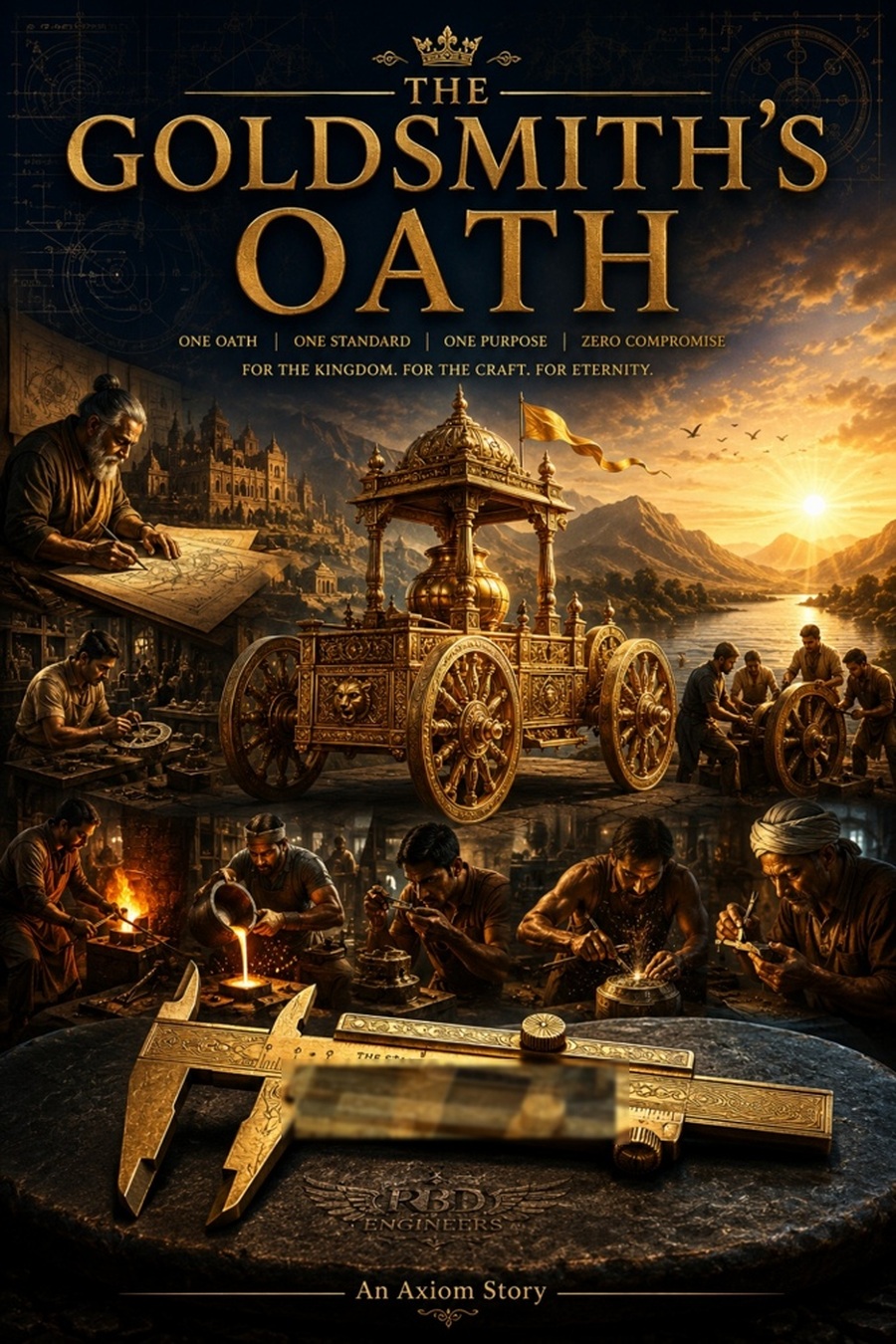
Every company has products.
A few have principles.
The rarest have stories.
This is ours.
"This story belongs to the people who build here."
The King's Command
Long ago, beneath the ancient Vindhya hills, there stood a kingdom blessed beyond measure. Its rivers never ran dry. Its harvests were generous. Temple bells greeted every dawn, while the first light of morning washed the sandstone palaces in gold.
Travellers believed the kingdom prospered because the gods had favoured it. The King knew better. Prosperity was never inherited. It had to be earned, protected and renewed. Every generation bore the same responsibility — to prove itself worthy of what had been entrusted to it.
For centuries the kingdom observed a sacred tradition. Once in every generation, during the Maha Kumbh, a ceremonial chariot would be offered to the River Goddess. It carried no king. It carried gratitude. It reminded every citizen that abundance was never a right; it was a blessing that had to be honoured. Legend held that if the chariot was flawless, the Goddess would bless the kingdom for another generation. But if even one hidden imperfection remained... the blessing would be broken. No king had ever dared discover whether the legend was true.
So, as every ruler before him had done, the King summoned the greatest craftsman in the realm. The old Master entered the royal court without haste. Age had curved his shoulders but never his spirit. A scar crossed one forearm, left behind by a furnace that had once betrayed an impatient apprentice many years before. His beard had turned silver. His hands had not forgotten precision.
The King descended from his throne before speaking — a gesture reserved only for those whose service stood beyond rank. "Master," he said, "one year from today our people will gather upon the sacred river. I ask you to build the ceremonial chariot."
The old craftsman bowed. "It shall be done." The King's expression remained steady. "But understand this. I do not ask for something beautiful. I do not ask for something magnificent. I ask for something flawless." The court fell silent. The Master raised his eyes. "I understand." "The Oath accepts nothing less."
For a long moment the King studied the old man. He had known his father. And before him, his grandfather. Three generations of craftsmen had served the Crown — not because they possessed extraordinary talent, but because they refused ordinary standards. The King nodded quietly. "I know."
The Master turned to leave. Just before reaching the great doors, he stopped. Without looking back, he spoke. "Your Majesty... the Oath demands one thing above all else." "And what is that?" "Time." A quiet pause followed. "If you ask me to hurry... you ask me to abandon it." For the first time that morning, the King's stern expression softened. "Then I shall never ask."
The Master returned to his workshop. It was no ordinary place of work. Stone chambers opened into broad courtyards. Covered sheds sheltered generations of tools. Smoke drifted gently from the furnaces as the rhythmic sound of hammers echoed through the morning air — a rhythm that had remained unchanged for decades. He knew this would be the greatest undertaking of his life.
The ceremonial chariot would contain hundreds of individual components: the body, the wheels, the axles, the sacred urns, the ceremonial bells and the crowning finial. No single craftsman could create it alone, because no single craft was sufficient to fulfil the Oath. Every component demanded a different skill. Every skill demanded a different workshop. Every workshop depended upon every other.
As dusk settled that evening, the Master gathered the leaders of every workshop beneath the great banyan tree at the heart of the compound. The oldest masters stood beside the youngest apprentices, all waiting in respectful silence. The Master looked slowly around the circle before speaking.
"The kingdom will one day praise this chariot. The Goddess will judge it. But neither is watching us." Curious faces looked back at him. "The Oath is."
It watches every drawing.
Every mould.
Every flame.
Every measurement.
And every decision that no one outside these walls will ever know was made.
He rested both hands upon the unfinished timber that would one day become the heart of the ceremonial chariot. "We do not build this together because the task is large." His eyes moved slowly from one workshop leader to the next. "We build it together because perfection belongs to no single pair of hands." One by one, they lowered their heads. "The Oath belongs to all of us." The work began.
The Web of Hands
The workshop awakened before sunrise. Smoke curled lazily from the stone chimneys as the furnaces breathed themselves to life. Hammers echoed across the courtyards in a rhythm that generations before them would have recognised. To an outsider it appeared to be many workshops working independently. The Master knew better. It was a living organism.
The first touch belonged to the Blueprint Drawers. Far from the noise of the furnaces, inside quiet stone chambers washed with morning light, they transformed imagination into certainty. Every wheel, every spoke, every hidden joint and every graceful curve first existed beneath their careful hands. They understood that a careless line upon parchment today would become an expensive mistake months later. So they questioned every dimension, measured every proportion, and only then — they drew.
When the drawings were complete, they passed into the hands of the First Builders. Others would eventually produce hundreds of identical components. These craftsmen produced only one. The first. The one that answered the most important question of all: Does the idea truly work? If the first sample failed, production never began. Their task was not simply to create; it was to protect every workshop that followed.
Beyond the city walls worked the Form Givers. Most visitors admired polished metal. The Form Givers admired empty space. With sand, clay and timber they created the moulds that would one day give shape to molten metal. They understood something few others did — that before anything can exist, its absence must first be shaped perfectly. Every edge was examined, every surface checked, and every mould earned the right to receive the fire.
Near the river stood the great furnaces. Here worked the Fire Masters. Many believed their craft was simply melting metal. Those who mastered fire knew better. Fire was alive. Too little heat and strength would never awaken. Too much and purity would quietly disappear. They did not watch numbers. They watched colour — the deep orange that whispered not yet, and the brilliant white that warned enough. Only when the flame itself gave permission did they continue.
Then came the Flow Keepers, who stood between chaos and control. Molten metal obeyed no man. It demanded patience — too quickly and air would be trapped within; too slowly and it would cool before reaching every corner of the mould. The Flow Keepers never forced perfection. They guided it.
Hidden beneath the workshops laboured the Truth Seekers. Here there were no assumptions, no opinions, no optimism. Only evidence. Every alloy was tested. Every measurement confirmed. Every property questioned. Beside them rested the Master's old brass caliper — not because it possessed magic, but because it represented something greater. Truth does not care what we believe. Truth measures. Truth verifies. Truth remains.
Beyond them waited the Finishers. They received castings that others considered complete. They smiled quietly. They knew better. Completion was only the beginning. With patient hands they ground, polished, smoothed and refined. Again and again they returned to the same surface, understanding that the final one percent often demanded more patience than the first ninety-nine. They never complained. Because excellence often hides in the last unseen detail.
Then came the Checkers — perhaps the least celebrated, certainly the most feared. Every workshop respected them, for they possessed one authority that no one else did. They could say no. No matter how many hours had been invested. No matter how urgently the kingdom waited. No matter who had made the component. If it failed the standard, its journey ended there. Their refusal protected everyone else's reputation. Sometimes the highest form of craftsmanship was the courage to refuse.
Only then did the Joiners begin. Piece by piece, hundreds of separate efforts slowly became one creation. Wheels met axles. Panels embraced the frame. The ceremonial urns found their place. Nothing was forced. Nothing resisted. Every component had to belong to every other until balance, movement and harmony became indistinguishable. Only then did the chariot begin to live.
And everywhere there were Learners — not standing behind the masters, but beside them. Holding lamps. Carrying tools. Watching far more than they spoke. They noticed the rhythm of experienced hands. They listened to conversations never intended as lessons and quietly absorbed habits no classroom could teach. The Master often said: "The Oath is never taught. It is witnessed." Most of the apprentices did not yet understand. One day they would.
No workshop hurried another. No department worked against another. Every hand trusted that every other hand carried the same Oath. One day the kingdom would admire a magnificent ceremonial chariot. Very few would ever understand what had truly created it. It was never the brilliance of one extraordinary craftsman. It was the unwavering integrity of every hand.
The Shadow of Doubt
The work continued with quiet devotion. Days became weeks, and weeks became months. Summer softened into autumn, autumn surrendered to winter, and still the rhythm within the workshops remained unchanged. Beside every master stood a learner — watching, listening, remembering. The Oath was never passed from one generation to the next through instruction alone. It was absorbed through example.
Beyond the workshop, another clock was quietly counting down. The sacred day approached. Pilgrims had already begun their journey towards the capital. Priests prepared the riverbanks. Musicians rehearsed the ancient hymns. Delegations from neighbouring kingdoms confirmed their arrival. Every sunrise shortened the time that remained. No one felt that weight more deeply than the Royal Minister.
History often mistakes anxious men for ambitious ones. The Minister was neither cruel nor impatient. He loved the kingdom every bit as deeply as the Master did, but his burden was different. Every promise made by the King, every guest who would travel for the ceremony, every expectation of the people rested upon his shoulders. Faith could survive hardship. Confidence rarely did.
One afternoon the Minister rode into the workshop without announcement. What surprised him most was not the craftsmen's discipline. It was their calm. No one appeared hurried. No one appeared anxious. No one behaved as though the most important deadline in the kingdom was only weeks away. He approached the Master, who was carefully examining one of the great wheels. "You seem remarkably calm." "I am working." "The ceremony is only weeks away." "I know." "Then why does no one seem to be working faster?"
"Because speed is not our work." The Minister drew a slow breath. "I am not asking for carelessness. I am asking for urgency." "There is urgency," replied the Master. "It simply does not look like panic."
He returned the following morning carrying news. "The Kingdom of Suran has completed their ceremonial chariot. They finished in nearly half the time. Fewer inspections. Less waiting between stages. Faster finishing. They claim the result is exactly the same." Silence settled across the workshop. For the first time, some of the younger apprentices wondered whether the old ways belonged to another age.
The old craftsman reached for the brass caliper resting beside him and turned it slowly in his hands. "This belonged to my father. And before him, to his father. They too were offered easier ways." "The world changes," said the Minister quietly. "Yes. It does. Should we not change with it?" The Master smiled, though there was sadness in his eyes. "We should. But never by abandoning what made us worthy of change."
"What if your principles destroy the very kingdom you are trying to protect?" The words echoed through the courtyard. The Master invited the Minister to walk beneath the banyan tree, away from listening ears. "When you were a boy, were you ever taught archery?" The Minister nodded. "What happens if the arrow is released too early?" "It misses." "And too late?" "It also misses." "So you see — speed alone has never found the target."
"I know what keeps you awake," the Master said quietly. "You fear disappointing the King. You fear disappointing the people. You fear history remembering your failure." The Minister lowered his eyes. "I do." "And I honour that." He lifted the brass caliper. "My fear simply begins where yours ends. If they see us compromise once, they will believe compromise belongs to the craft. That lesson will outlive both of us."
"And if we fail?" "Then we fail with honour. But if we compromise — we fail forever." The Minister left before sunset without another word. Yet the conversation lingered long after he was gone. Around the evening fires the apprentices whispered among themselves. Was the rival kingdom wiser? Or merely faster? Could both paths truly lead to the same destination?
Only one apprentice remained silent. As the others drifted away, he noticed that the Master's brass caliper had been left upon the workbench. He picked it up carefully with both hands, brushed away the fine layer of dust, and returned it to exactly the place from which it had been taken. Across the courtyard the Master noticed. He said nothing. Some lessons never needed words. Some guardians revealed themselves long before they understood why.
The Midnight Discovery
The final day arrived. The ceremonial chariot stood complete. Months of devotion had taken visible form. Every wheel had found its axle. Every panel rested perfectly upon the frame. The sacred urns stood polished and ready, while the ceremonial bells waited silently for the dawn. The last inspection began beneath the glow of oil lamps.
The Master walked slowly around the chariot. The old brass caliper rested lightly in his hand. He was not searching for mistakes. He was searching for truth. Then he stopped. His hand rested upon one of the great wheels. Without a word, he lifted the caliper, adjusted its scale and measured the polished surface before him. He measured again. Then he remained perfectly still.
"Gather everyone." His voice was calm. Too calm. Within moments every workshop stood assembled beneath the lamps. Masters. Craftsmen. Apprentices. Even the Minister, who had returned to witness the final inspection, stepped forward quietly. "This component..." He paused. "...is not perfect." The words fell heavier than iron.
One of the Chief Checkers stepped forward. "Master — we inspected this wheel three times. It passed every measurement." "I know. So did I." Without another word he placed the brass caliper into the Checker's hands. The craftsman measured. Looked again. Measured once more. The colour slowly drained from his face. "I... did not see it." "No. None of us did."
The flaw could not be seen with the eye. It could barely be measured. Only the caliper revealed it. A variation no larger than the width of a grain of sand. Invisible. Yet real. "It will not fail today," the Master said. "It may not fail tomorrow. But when the sacred vessel is placed upon this chariot, when its full weight rests upon this wheel — it will break."
The investigation began immediately. No workshop defended its own work. No one searched for someone to blame. The Oath demanded something greater. It demanded honesty. The Blueprint Drawers returned to their original drawings. Nothing had changed. The First Builders brought forward the original prototype. Every measurement matched. The Form Givers carefully inspected the moulds. No hidden cracks, no distortion. The Fire Masters revisited every firing record. Still the flaw remained unexplained.
Deep into the night, the laboratory door opened. One of the Truth Seekers emerged carrying the Master's caliper. He approached and quietly pointed to a single reading. "The flaw is not in the metal. It is not in the mould. It is not in the fire. It is not in the design." He paused. "It is in the finish."
One of the Finishers stepped forward. His shoulders trembled. "I know. I remember. There was one evening — the Minister had warned us we were falling behind. I hurried. Only once. I believed one final pass would make no difference. I believed no one would ever know." The silence that followed was almost unbearable. The Minister closed his eyes. He remembered the conversation. He remembered his own urgency. He remembered every word.
The Finisher fell to his knees. "I have broken the Oath." The Master walked towards him. He did not speak immediately. Instead, he helped the craftsman to his feet. "No. You have revealed the Oath. If this flaw had remained hidden, the Oath would have been broken. But because truth was chosen over pride — the Oath still lives." No one felt relief. Only responsibility. "We have one night. Not to save a deadline. To save our standard." Without another word, every craftsman returned to his place.
The Night of the Oath
No one spoke about the deadline. No one spoke about the King. No one spoke about the ceremony that would begin with the sunrise. Those things belonged to tomorrow. Tonight belonged to the Oath.
The Joiners began dismantling the great chariot with the same care that had created it. Piece by piece, wheel by wheel, months of patient work disappeared before their eyes. There was no hesitation, no frustration, no trace of resentment. Every movement carried the quiet discipline with which the chariot had first been assembled. Nearby, the Finishers returned to their work. The damaged surface was patiently removed, layer by layer. The wheel was reshaped, measured, refined, polished — not quickly, but correctly.
Around them the workshops came alive once more. The only question that mattered was: Is it right? The hours passed quietly. The lamps burned lower. The night grew colder. Exhaustion settled over the workshop like a heavy blanket. Yet no one suggested stopping. The Oath did not rest because people became tired.
Just before dawn, the repaired wheel was finally ready. The Joiners lifted it carefully into place. Every bolt was tightened. Every connection aligned. For the briefest moment, everyone believed the work was finished. Then a quiet voice broke the silence. "Master..." It was the youngest apprentice. He still held the oil lamp he had carried throughout the night. "Should we... measure it once more?"
Silence filled the workshop. Because every master standing there realised the same thing at exactly the same moment. For one fleeting instant they had trusted exhaustion more than the Oath. The Master reached for the brass caliper. Without a word he measured the wheel. The reading was perfect. He measured again. Still perfect. A third time. Perfect. Only then did he close the instrument. He looked at the apprentice. "The measurement was never for the wheel." The young boy looked puzzled. The Master smiled. "It was for us."
No one forgot those words. Not that morning. Not ever again. The Oath had already found its next guardian. The final inspection continued — this time with no trace of fatigue, no assumption, no impatience. The Master walked slowly around the completed chariot one final time. He stopped before the repaired wheel. Measured it. Looked once more. Then quietly closed the caliper. For the first time in many hours, he smiled. "It is perfect."
The words were spoken softly. Yet they travelled through the workshop like the first light of dawn. No one cheered. No one celebrated. Instead, the craftsmen looked quietly at one another — not with pride, but with gratitude. Together they had protected something far greater than a ceremonial chariot. They had protected the standard that defined them. "And trust," the Master said, turning to the Minister, "must never be rushed." Outside, the first rays of dawn touched the eastern sky. The Night of the Oath had ended. The Day of the Kingdom had begun.
The Ritual
Dawn arrived quietly. A thin veil of mist drifted across the sacred river as the first rays of sunlight touched the waiting chariot. Thousands had gathered along the riverbank. Priests stood ready beside the ceremonial vessel. Musicians waited in silence. Families filled the steps leading to the water, their eyes fixed upon the masterpiece that stood before them.
They saw polished bronze. Perfect wheels. Beautiful carvings. They saw certainty. They did not see the doubt that had filled the previous night. They did not see months of work willingly dismantled because one hidden imperfection refused to remain hidden. They did not see exhausted craftsmen choosing truth over convenience. That is the nature of true craftsmanship. When it succeeds, its greatest efforts remain invisible.
The sacred vessel was carried with reverence towards the chariot. The repaired wheel accepted the weight. The chariot remained perfectly still. The ceremony continued. The blessing was complete. The kingdom rejoiced. No one beyond the workshops ever realised how close that morning had come to being different. Nor did they need to. The Oath had done its work.
Later, when the celebrations had faded and the riverbank had grown quiet, the King walked beside the Master. "Tell me honestly — how did you build something so flawless?" "We did not. No single pair of hands built this. It belonged first to those who imagined it. Then to those who proved it. To those who shaped it. To those who mastered fire. To those who guided the flow. To those who searched for truth. To those who refined it. To those who inspected it. To those who assembled it. And finally, to those who quietly learned what they were watching." He smiled softly. "I merely carried the Oath before them."
The King looked once more at the chariot and, for the first time, truly understood. Great creations are rarely the work of extraordinary individuals. They are the work of ordinary people who refuse ordinary standards.
Nearby, the Royal Minister approached the Master. Then, to the surprise of everyone near him, he bowed — not before the King, but before the craftsman. "I owe you an apology." "There is nothing to forgive." "I thought speed would save us." The Master rested one hand upon the repaired wheel. "Speed saves today's deadline. Standards save tomorrow." A quiet smile appeared. "The Oath belongs to all of us." "It always did."
Nearby, the apprentices watched silently. One of them looked towards the brass caliper resting in the Master's hands. It no longer appeared to be a measuring instrument. It had become a promise. One day it would belong to someone else — not because it had been inherited, but because it had been earned.
Tomorrow morning, the gates will open once again. The pattern makers will begin their drawings. The foundry will light its furnaces. The machinists will shape metal. Quality will measure. Assembly will fit. Dispatch will prepare. And maintenance will quietly keep everything moving. Every hand will begin a different task. Every hand will continue the same Oath. That is why perfection has never belonged to one department. It has always belonged to the trust between them.
The Goldsmith's Oath was never asking you to admire a craftsman. It was inviting every person to recognise their place within the same promise.
Tomorrow morning... the Oath begins again.
The oath was never carried by one pair of hands.
Every Axiom Story begins with one conversation. Bring me the quality your brochure cannot carry.
Commission a story →